
Strategic Visibility Through AI Governance for Business Growth
Artificial intelligence is changing how organizations operate, compete, and grow. From automated customer service to advanced forecasting systems, AI is becoming part of daily business operations. However, as AI expands across departments, many organizations face a critical challenge. They struggle to maintain visibility, accountability, and control over increasingly complex systems. This is where AI governance for strategic visibility becomes essential.
Modern enterprises need more than powerful algorithms. They need structured oversight that aligns technology with business goals. Effective AI govercwnance, supported by strong AI oversight, AI accountability, and AI transparency, helps leaders understand how AI systems make decisions and how those decisions affect performance. When implemented correctly, strategic visibility through AI governance enables organizations to innovate confidently while reducing operational risks.

Understanding AI Governance in a Modern Business Context
Many companies initially approach artificial intelligence as a technical deployment. Its true impact, however, extends far beyond technology, influencing operating models, decision-making processes, and long-term business development.
. A strong AI governance framework ensures that AI operates according to organizational values, regulatory requirements, and strategic objectives.
The growing demand for responsible AI is driven by increasing concerns about fairness, transparency, and risk. Companies today rely heavily on AI-powered recommendations, predictive analytics, and automated workflows. Without proper governance policies, governance systems, and AI compliance, organizations may face regulatory penalties, reputational damage, or poor business outcomes. As a result, AI governance business context strategic visibility has become a boardroom priority rather than simply a technical concern.
What AI Governance Means for Organizations
At its core, AI governance creates a structured environment where AI systems can operate safely and effectively. It establishes clear responsibilities, decision rights, and oversight mechanisms. Through well-defined AI governance practices, organizations gain confidence that their AI initiatives support business goals while minimizing unintended consequences.
Think of governance as the traffic system of AI adoption. Roads allow movement. Traffic signals provide order. Without signals, even the best roads become dangerous. Similarly, AI systems require governance controls, AI lifecycle management, and AI implementation standards to ensure smooth operations and sustainable growth.
The Growing Need for Governance in AI-Driven Enterprises
The rapid expansion of AI has created unprecedented opportunities. Yet it has also introduced new forms of risk. Organizations now manage hundreds of AI models that influence customer interactions, operational decisions, and strategic planning. This complexity increases the need for effective AI risk management and AI monitoring.
Research consistently shows that executives are prioritizing trustworthy AI initiatives because trust directly impacts adoption. Customers, investors, and regulators increasingly expect organizations to demonstrate transparency and accountability. Strong governance supports these expectations while enabling long-term enterprise AI adoption and digital transformation.

Strategic Visibility Through AI Governance
Strategic success depends on visibility. Leaders cannot manage what they cannot see. Strategic visibility through AI governance provides organizations with a comprehensive view of AI activities, performance metrics, and associated risks. This visibility transforms AI from a black box into a measurable business asset.
Organizations that establish robust governance mechanisms gain better insight into decision processes, operational outcomes, and emerging opportunities. Through enhanced AI observability, AI performance monitoring, and business intelligence, executives can make informed decisions based on reliable information rather than assumptions.
Improving Transparency Across Business Functions
Transparency creates confidence throughout the organization. When employees understand how AI systems work and why decisions are made, resistance decreases. Effective AI transparency also strengthens collaboration between technical teams and business stakeholders.
Imagine a retail company using AI for inventory forecasting. Without visibility, managers may question recommendations. With proper governance and AI monitoring, they can trace decisions back to verified data sources. This level of transparency improves operational trust and supports stronger business outcomes.
Enhancing Executive Decision-Making
Executives face increasing pressure to make fast decisions in uncertain environments. Effective AI governance strategy provides leaders with reliable information, clear accountability structures, and actionable insights. This strengthens AI decision making and improves organizational responsiveness.
By combining AI analytics, contextual intelligence, and governance oversight, leaders gain deeper understanding of performance trends and risk exposure. The result is stronger strategic decision making, better resource allocation, and improved alignment between technology investments and business objectives.
Strengthening Accountability and Oversight
Accountability remains one of the most important elements of governance. Every AI system should have designated owners, documented responsibilities, and measurable performance standards. Strong governance accountability reduces confusion and ensures prompt action when issues arise.
Organizations increasingly deploy automated AI oversight tools that continuously monitor system behavior. These solutions support AI compliance and accountability by identifying anomalies, detecting risks, and providing detailed audit trails. Such capabilities strengthen organizational trust while improving governance effectiveness.
Why AI Governance Is Essential for Business Evolution
Business environments change constantly. Customer expectations shift. Regulations evolve. Competitive pressures intensify. Organizations that fail to adapt often struggle to remain relevant. AI governance business evolution strategies help companies navigate these changes while maintaining stability and control.
Governance enables organizations to innovate responsibly. Instead of slowing progress, it creates a foundation for sustainable experimentation. Strong governance structures support business innovation, AI-driven growth, and long-term enterprise transformation while ensuring that risks remain manageable.
Aligning AI Initiatives With Business Goals
Many AI projects fail because they lack alignment with organizational objectives. Effective governance bridges this gap by connecting technology investments to measurable business outcomes. Through strong AI business strategy and AI operational alignment, organizations can prioritize initiatives that deliver real value.
When governance aligns AI efforts with strategic priorities, decision-makers gain greater confidence in technology investments. This alignment supports improved efficiency, increased productivity, and stronger competitive positioning across the enterprise.
Supporting Innovation While Managing Risk
Innovation and risk management are often viewed as opposing forces. In reality, they work best together. Effective AI governance and risk management creates an environment where experimentation can occur safely without exposing the organization to unnecessary threats.
Organizations use risk evaluation, risk mitigation, and risk-based governance frameworks to assess potential impacts before deployment. This balanced approach encourages innovation while protecting organizational assets, customer trust, and regulatory compliance.
Building Sustainable Competitive Advantage
Competitive advantage rarely comes from technology alone. It comes from how organizations manage and scale technology effectively. Governance provides the structure necessary to transform AI capabilities into lasting business value.
Companies with mature governance programs often achieve greater business resilience, stronger operational efficiency, and improved AI scalability. These advantages enable sustained growth even during periods of market disruption and uncertainty.

The Role of Contextual AI Governance in Organizational Adaptation
Modern organizations operate in environments that change every day. Customer behavior evolves. Market conditions shift. Regulations expand. Traditional governance models often struggle to keep pace with these changes. This is why contextual AI governance has become increasingly important. It allows organizations to adapt governance decisions based on real-world conditions rather than relying solely on static rules.
An effective adaptive governance framework continuously evaluates business context, operational priorities, and risk exposure. By incorporating contextual awareness, situational intelligence, and real-time context, organizations can make smarter decisions while maintaining oversight. This flexibility supports long-term organizational adaptation and strengthens resilience during periods of disruption.
Understanding Context-Aware Governance Models
A context-aware AI system does not operate in isolation. It considers changing circumstances before making decisions. Governance frameworks must follow the same principle. Context-aware AI governance evaluates business conditions, customer expectations, regulatory requirements, and operational risks before enforcing policies.
Think of it as driving with GPS navigation. A static map may show the road. A smart navigation system adjusts based on traffic, weather, and road closures. Similarly, contextual governance adjusts oversight mechanisms based on emerging conditions. This improves contextual accuracy and supports better business outcomes.
Adapting Governance to Changing Business Conditions
Organizations face constant change. New competitors enter markets. Consumer expectations evolve. Economic conditions fluctuate. Effective governance frameworks must adapt without losing consistency. This is a key component of AI governance and organizational adaptation.
An adaptive governance model enables organizations to revise policies, update controls, and adjust monitoring processes as conditions change. Such flexibility strengthens business agility, improves market adaptation, and supports sustainable growth across complex operating environments.
Managing Dynamic Risks Across AI Systems
AI risks are not static. A model that performs well today may become less effective tomorrow due to changing data patterns or evolving business conditions. Effective governance therefore requires continuous assessment and adjustment.
Organizations use AI operational risk frameworks, bias detection tools, and AI safeguards to monitor changing risk levels. Combined with human oversight, these mechanisms help maintain system reliability while reducing the likelihood of costly errors or compliance failures.

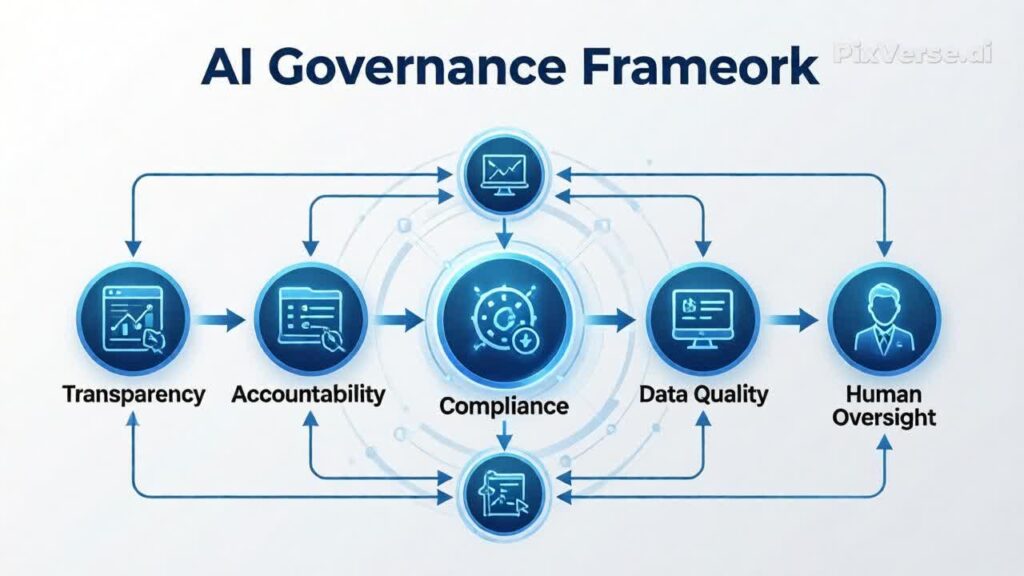
Core Pillars of Effective AI Governance
Successful governance programs share several foundational elements. These pillars provide structure, consistency, and accountability across the AI lifecycle. Together they create a framework that supports innovation while protecting organizational interests.
Organizations that invest in these pillars often achieve greater governance maturity and stronger business outcomes. They also build trust among customers, regulators, employees, and investors who increasingly demand responsible AI practices.
Transparency and Explainability
Transparency is the foundation of trust. When stakeholders understand how AI systems reach conclusions, confidence increases. Explainability helps organizations communicate AI decisions in ways that are understandable to both technical and non-technical audiences.
A transparent AI environment improves AI trust, strengthens accountability, and supports strategic visibility. It also makes audits easier and helps organizations identify potential problems before they escalate into larger issues.
Compliance and Regulatory Readiness
The regulatory landscape surrounding AI continues to evolve. Organizations must prepare for increasing scrutiny regarding data privacy, algorithmic fairness, and operational accountability. Strong AI compliance management practices help businesses stay ahead of changing requirements.
Compliance readiness requires documented controls, regular assessments, and proactive governance measures. Organizations that prioritize regulatory compliance and audit readiness reduce legal risks while demonstrating commitment to responsible AI practices.
Data Quality and Integrity
Even the most advanced AI system is only as reliable as the data it uses. Poor-quality information can produce inaccurate recommendations, flawed predictions, and harmful outcomes. Data integrity therefore remains a critical governance priority.
Strong data governance supports AI lifecycle management, improves model performance, and enhances operational reliability. High-quality data also strengthens business intelligence by ensuring that decisions are based on accurate and trustworthy information.
Human Oversight and Accountability
Despite rapid advances in automation, human judgment remains essential. AI can process vast amounts of information. However, people provide context, ethics, and critical thinking that machines cannot fully replicate.
Effective human-in-the-loop governance frameworks combine technological efficiency with human expertise. This approach supports human-AI collaboration, strengthens accountability, and ensures that important decisions receive appropriate review and oversight.

How AI Governance Supports Organizational Adaptation
Adaptability has become a defining characteristic of successful organizations. Companies that respond quickly to change often outperform competitors during periods of uncertainty. Governance plays a critical role in enabling this responsiveness.
Rather than creating barriers, effective governance provides a structured environment where organizations can adjust strategies confidently. This strengthens resilience while supporting continuous innovation and growth.
Faster Response to Market Changes
Market conditions can change rapidly. Consumer preferences evolve. New technologies emerge. Competitive threats appear unexpectedly. Organizations need systems that can identify and respond to these changes quickly.
Strong governance improves operational visibility, supports faster risk assessment, and enables timely decision-making. This contributes directly to business adaptation, stronger resilience, and more effective responses to emerging opportunities.
Enabling Agile Decision-Making
Speed matters in modern business. Delayed decisions can result in lost revenue, missed opportunities, or competitive disadvantages. Governance frameworks support agility by providing clear decision-making processes and reliable information.
Organizations that leverage AI decision-making frameworks gain better visibility into operational performance and risk exposure. This enables leaders to act quickly while maintaining confidence in the quality of their decisions.
Improving Cross-Functional Collaboration
AI initiatives often involve multiple departments. Technology teams build systems. Legal teams manage compliance. Business units focus on outcomes. Governance creates a shared framework that aligns these groups around common objectives.
Improved collaboration strengthens enterprise governance, reduces duplication of effort, and enhances organizational efficiency. It also supports smoother implementation of AI initiatives across the enterprise.

Leadership’s Role in AI Governance and Transformation
Leadership commitment is one of the strongest predictors of governance success. Governance cannot be delegated entirely to technical teams. Senior leaders must actively participate in defining priorities, allocating resources, and establishing accountability structures.
Organizations with engaged leadership often achieve higher governance maturity and stronger transformation outcomes. Their governance efforts become strategic initiatives rather than isolated compliance exercises.
Executive Responsibilities in AI Oversight
Executives play a crucial role in setting governance expectations. They establish policies, define risk tolerance levels, and ensure alignment between AI initiatives and business objectives.
Strong leadership also promotes transparency and accountability throughout the organization. By actively supporting governance efforts, executives create an environment where responsible innovation can flourish.
Creating a Governance-First Culture
Culture influences how governance operates in practice. Policies alone are not enough. Employees must understand the importance of responsible AI and embrace governance as part of their daily work.
Organizations that foster governance-focused cultures often experience higher compliance rates, stronger collaboration, and improved trust. These cultural foundations support long-term transformation and sustainable growth.
Balancing Innovation With Control
Innovation drives growth. Governance provides stability. Successful organizations understand that both are necessary. The challenge lies in balancing flexibility with oversight.
Effective governance frameworks establish clear boundaries without restricting creativity. This allows organizations to pursue new opportunities while maintaining operational control and managing risk effectively.
Implementing AI Governance Frameworks Successfully
Implementing governance requires careful planning and sustained commitment. Organizations should view governance as an ongoing journey rather than a one-time project. Success depends on alignment, communication, and continuous improvement.
The most effective programs evolve over time. They adapt to changing business requirements while maintaining consistency in governance principles and objectives.
Assessing Organizational Readiness
Before implementing governance initiatives, organizations should evaluate their current capabilities. This includes assessing technology infrastructure, governance maturity, risk management practices, and organizational culture.
A readiness assessment identifies strengths and weaknesses while helping leaders prioritize investments. It also provides a foundation for long-term governance planning.
Establishing Governance Policies and Standards
Clear policies create consistency. They define expectations, responsibilities, and acceptable practices across the organization. Effective governance standards also support compliance and accountability.
Organizations should establish documented procedures covering AI development, deployment, monitoring, and retirement. These standards ensure that governance remains consistent across diverse AI initiatives.
Monitoring and Continuous Improvement
Governance is never finished. AI systems evolve. Regulations change. Business priorities shift. Continuous monitoring ensures that governance frameworks remain effective over time.
Regular reviews, audits, and performance assessments help organizations identify improvement opportunities. This ongoing process strengthens governance maturity and supports long-term organizational success
Industry Applications of AI Governance
The value of AI governance for strategic visibility becomes clearer when examined across industries. Every sector faces unique challenges. However, all organizations share a common need for accountability, transparency, and risk management. Governance frameworks help transform AI from a technical asset into a strategic business capability.
Organizations that combine AI governance strategy, AI compliance, and operational oversight often achieve better outcomes than those that focus only on technology. The result is stronger trust, improved performance, and greater business resilience.
Financial Services
Financial institutions process enormous amounts of sensitive data every day. AI supports fraud detection, credit scoring, customer service, and investment analysis. Because these activities directly affect customers and regulatory obligations, governance plays a critical role.
Banks use AI compliance and accountability frameworks to monitor decision quality, ensure fairness, and maintain regulatory alignment. Strong governance also supports audit readiness while reducing operational risk. As a result, financial organizations can innovate confidently without compromising trust.
Healthcare
Healthcare organizations rely on AI for diagnostics, patient monitoring, treatment recommendations, and operational planning. Mistakes in these environments can have serious consequences. Therefore, governance is essential for maintaining safety and reliability.
Strong governance frameworks ensure that AI systems operate transparently and ethically. They also support data privacy requirements while improving confidence among patients, providers, and regulators. This balance allows healthcare organizations to benefit from innovation while maintaining high standards of care.
Manufacturing
Manufacturing companies increasingly use AI to optimize production, forecast maintenance needs, and improve supply chain performance. These systems can generate substantial efficiency gains. However, they also introduce operational risks that require oversight.
Governance frameworks help manufacturers monitor performance, validate recommendations, and ensure operational consistency. This supports intelligent automation, improves operational efficiency, and strengthens long-term competitiveness.
Retail and Customer Experience
Retailers use AI to personalize customer interactions, manage inventory, and optimize pricing strategies. These applications can significantly improve customer satisfaction and profitability. However, they also require careful governance.
By implementing transparent governance practices, retailers can ensure responsible use of customer data while maintaining trust. Effective oversight also supports better decision-making and stronger customer relationships.
Common Challenges in AI Governance
Despite its benefits, implementing governance is not always straightforward. Organizations frequently encounter obstacles related to scale, culture, technology, and compliance. Understanding these challenges helps leaders develop more effective governance strategies.
The good news is that most governance challenges can be addressed through planning, communication, and continuous improvement. Organizations that recognize potential barriers early often achieve stronger results.
Governance Complexity at Scale
As AI adoption grows, governance becomes more complex. Organizations may manage dozens or even hundreds of AI systems operating across multiple business units. Coordinating oversight across such environments can be difficult.
Without a clear governance architecture, organizations risk creating inconsistent policies and fragmented accountability structures. A centralized framework helps reduce complexity while improving visibility and control.
Resistance to Organizational Change
People naturally resist change when they do not understand its purpose. Employees may view governance as unnecessary bureaucracy or an obstacle to innovation. This perception can slow adoption and reduce effectiveness.
Successful organizations address resistance through education, communication, and leadership support. When employees understand how governance protects both the organization and its stakeholders, acceptance often increases significantly.
Managing Ethical and Compliance Risks
AI introduces unique ethical considerations. Bias, transparency concerns, and accountability issues can create significant challenges if not addressed properly. Regulatory expectations are also evolving rapidly.
Organizations must therefore establish robust oversight mechanisms. Strong ethical AI, responsible AI, and compliance practices help reduce risks while strengthening stakeholder confidence in AI-driven operations.
Best Practices for Building Adaptive AI Governance
Organizations seeking long-term success should focus on governance practices that support flexibility, accountability, and continuous learning. Adaptive governance is not about controlling every action. It is about creating a framework that allows innovation to thrive safely.
The most successful governance programs evolve alongside business objectives. They remain flexible enough to accommodate change while maintaining consistent standards and accountability.
Integrating Governance Into Business Strategy
Governance should not operate independently from business strategy. Instead, it should be embedded within broader organizational objectives. This ensures that AI investments contribute directly to measurable outcomes.
Organizations that align governance with strategic priorities often experience stronger business performance and improved transformation results. Governance becomes a driver of value rather than simply a compliance requirement.
Establishing Risk-Based Governance Models
Not all AI systems carry the same level of risk. A recommendation engine may require different oversight than a healthcare diagnostic system. Effective governance recognizes these differences.
A risk-based governance approach allocates resources according to potential impact. High-risk applications receive greater scrutiny while lower-risk systems operate with more flexibility. This improves efficiency without compromising accountability.
Promoting Continuous Learning and Adaptation
Technology evolves rapidly. Governance frameworks must evolve as well. Organizations should regularly review policies, assess emerging risks, and incorporate lessons learned from previous initiatives.
Continuous learning strengthens governance maturity while supporting innovation. It also helps organizations remain competitive in increasingly dynamic business environments.
The Future of AI Governance for Strategic Visibility and Business Growth
The future of AI governance will be shaped by increasing automation, stronger regulatory requirements, and growing demand for transparency. Organizations will need governance systems that operate at the same speed as modern AI technologies.
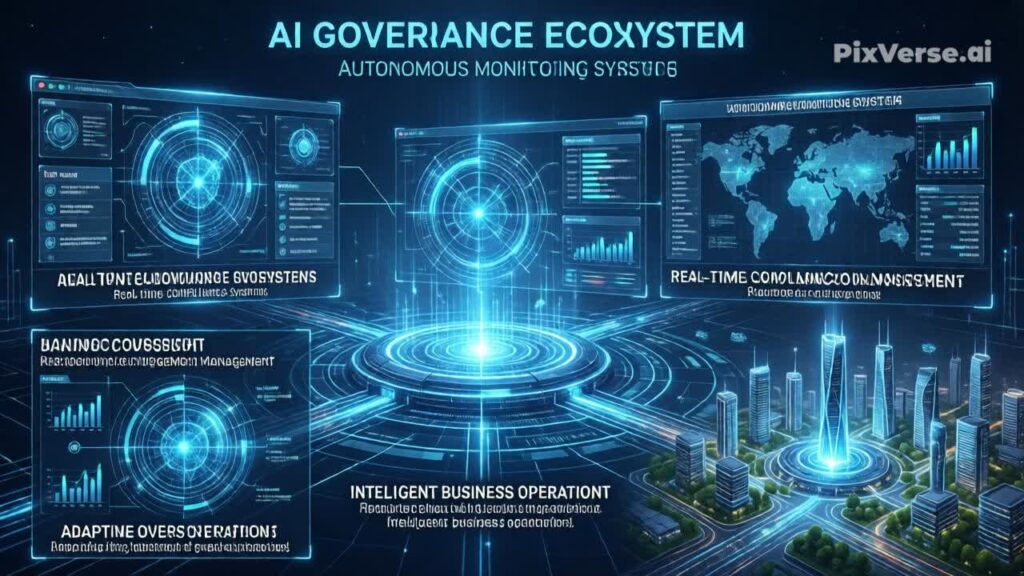
Future governance models will emphasize adaptability, real-time monitoring, and intelligent oversight. These capabilities will help organizations maintain visibility and control even as AI systems become more sophisticated.
Emerging Governance Technologies
New governance technologies are already transforming oversight processes. Advanced monitoring platforms can detect anomalies, evaluate risks, and generate compliance reports automatically.
These innovations support governance automation, improve operational efficiency, and provide deeper visibility into AI system performance. As technology matures, governance capabilities will become increasingly proactive rather than reactive.
Adaptive Governance Models
Traditional governance frameworks often rely on static policies. Future models will be more dynamic. They will continuously adjust controls based on changing business conditions and risk levels.
This evolution toward adaptive governance will improve responsiveness while supporting stronger organizational resilience. It will also help organizations manage increasingly complex AI ecosystems.
Preparing Organizations for Next-Generation AI
The next generation of AI will be more autonomous, more powerful, and more deeply integrated into business operations. Organizations must prepare for this future by investing in governance capabilities today.
Building strong governance foundations now will help organizations navigate future challenges with confidence. It will also support sustainable growth, innovation, and long-term competitive advantage.
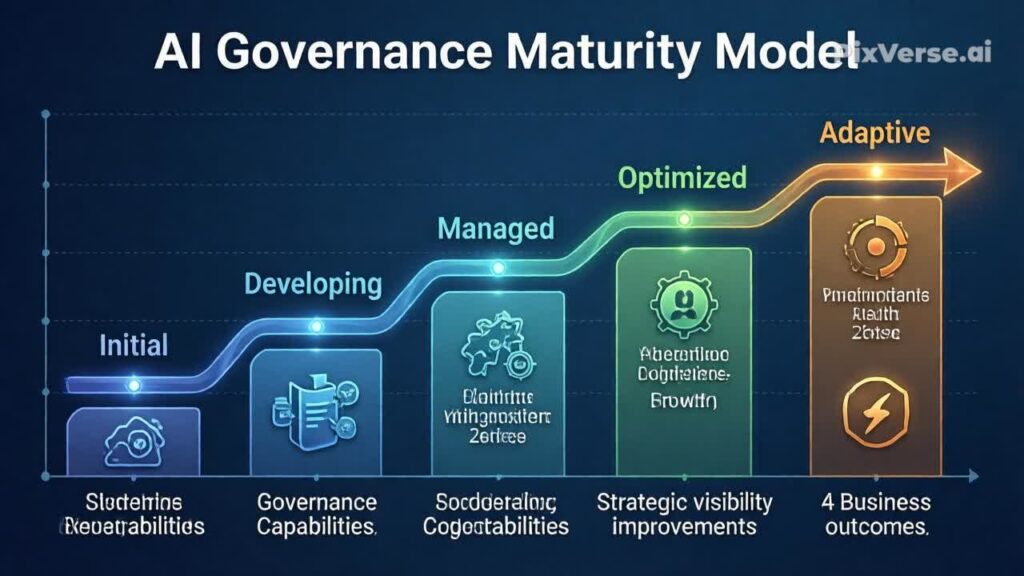
AI Governance Maturity Model
The following table illustrates how governance capabilities typically evolve as organizations increase AI adoption.
| Maturity Level | Governance Characteristics | Business Impact |
| Initial | Basic policies and limited oversight | High risk and low visibility |
| Developing | Standardized governance procedures | Improved compliance and consistency |
| Managed | Advanced monitoring and accountability | Better decision-making and efficiency |
| Optimized | Automated governance and real-time oversight | Strong strategic visibility and resilience |
| Adaptive | Context-aware governance with continuous improvement | Sustainable growth and competitive advantage |
Real-World Case Study: Governance Driving Transformation
A large financial institution implemented a comprehensive AI governance framework after expanding its use of machine learning models across lending and fraud detection operations. Initially, executives struggled to understand how various models influenced customer outcomes.
After introducing centralized governance controls, standardized monitoring processes, and stronger accountability mechanisms, the organization achieved significantly greater visibility into model performance. Decision-making improved. Compliance reporting became faster. Customer trust increased. Most importantly, leaders gained confidence that AI initiatives supported strategic objectives while maintaining regulatory alignment.
This example demonstrates how AI governance supports business evolution by transforming oversight from a compliance function into a source of competitive advantage.
Expert Insight
“Organizations do not fail because they adopt artificial intelligence. They fail because they adopt it without understanding, oversight, and accountability.”
This observation captures the essence of modern governance. Technology alone does not create value. Sustainable value emerges when innovation is guided by clear principles, effective oversight, and strategic alignment.
Conclusion
AI governance for strategic visibility is no longer optional. As organizations expand their use of artificial intelligence, governance becomes essential for maintaining transparency, accountability, and operational control. Strong governance frameworks provide the visibility leaders need to make informed decisions and manage risks effectively.
The connection between AI governance business evolution and AI governance organizational adaptation is becoming increasingly clear. Organizations that invest in governance today are better positioned to innovate responsibly, respond to change quickly, and build lasting competitive advantages. Through strategic visibility through AI governance, businesses can transform uncertainty into opportunity while preparing for the next era of intelligent enterprise growth.

Frequently Asked Questions
What is AI governance for strategic visibility?
AI governance for strategic visibility refers to the policies, processes, and oversight mechanisms that provide organizations with clear insight into how AI systems operate, make decisions, and impact business outcomes.
How does AI governance support business evolution?
Governance aligns AI initiatives with organizational goals, improves accountability, reduces risk, and creates a foundation for sustainable innovation. This helps businesses evolve while maintaining control and compliance.
Why is organizational adaptation important in AI governance?
Business environments constantly change. AI governance and organizational adaptation ensure that governance frameworks remain effective as technology, regulations, and market conditions evolve.
What are the key components of an AI governance framework?
Core components include AI transparency, compliance management, data quality controls, human oversight, accountability structures, risk management processes, and continuous monitoring capabilities.
How can companies implement AI governance successfully?
Organizations should assess readiness, establish governance policies, define accountability structures, implement monitoring tools, and continuously improve governance practices over time.
What challenges do organizations face when adopting AI governance?
Common challenges include governance complexity, resistance to change, compliance requirements, ethical concerns, scalability issues, and maintaining consistent oversight across multiple AI systems.
Pingback: AI Governance for Business Operations: Building Effective Business Documents and Governance Systems