
AI Governance for Business Operations: Building Effective Business Documents and Governance Systems
Artificial intelligence is transforming how organizations make decisions, automate processes, and drive innovation, making AI Governance for Business Operations essential for ensuring responsible, secure, and compliant AI adoption. A strong governance framework helps businesses reduce risks, maintain regulatory compliance, improve transparency, and align AI systems with long-term organizational goals.
Artificial intelligence is rapidly reshaping modern organizations, creating new opportunities for efficiency, automation, and smarter decision-making. However, as AI becomes embedded in daily operations, businesses need clear governance systems to ensure responsible and compliant use. This is where ai governance business documents play a critical role. They provide structured guidance for managing risks, defining accountability, and supporting long-term business objectives. A well-designed governance framework helps organizations strengthen AI compliance, improve AI transparency, and maintain effective AI oversight across departments. Moreover, adopting ai business-specific governance medium strategies allows companies to align AI initiatives with industry requirements, operational priorities, and evolving regulations while building trust and sustainable growth.
What AI Governance Actually Is (And What It Is Not)
AI governance is the system of policies, procedures, standards, and oversight mechanisms used to manage AI technologies throughout their lifecycle. It ensures organizations can define AI vision and scope, establish clear accountability, and monitor performance consistently. Rather than limiting innovation, governance creates a structured environment where AI can operate safely and effectively. Strong AI governance standards, AI transparency, and AI accountability help organizations understand how AI systems make decisions and how those decisions affect stakeholders.
Many leaders mistakenly assume governance means bureaucracy. In reality, governance is not about creating unnecessary obstacles. It is not simply regulatory paperwork or technical monitoring. Instead, it combines AI ethics, AI oversight, and business strategy into a practical operating model. Think of governance as the traffic signals of a busy city. The signals do not stop movement. They allow everyone to move efficiently while reducing collisions and confusion.

Why AI Governance Business Documents Matter in Modern Organizations
Every successful governance program depends on documentation. Organizations cannot manage AI consistently if expectations remain unwritten. Well-structured ai governance business documents establish a common language across departments. They define acceptable practices, approval processes, reporting requirements, and accountability structures. Through effective AI governance documentation, leaders create clarity that supports operational consistency and regulatory readiness.
Documentation also protects organizations during audits, investigations, and compliance reviews. Clear records demonstrate that the business actively works to manage AI compliance, maintain AI governance policies, and monitor operational risks. Imagine two companies facing the same regulatory inquiry. One has documented controls and governance procedures. The other relies on informal discussions. The first organization can demonstrate due diligence while the second struggles to prove accountability.
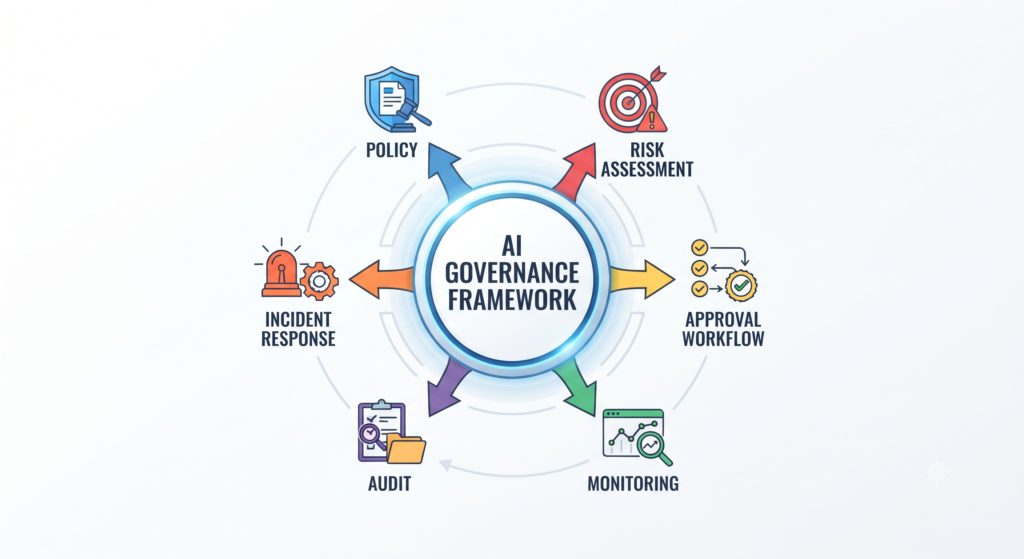
Quick Fact Table: Benefits of Governance Documentation
| Governance Function | Business Benefit |
| Policy Documentation | Consistent decision-making |
| Risk Registers | Better risk visibility |
| Audit Records | Easier compliance reviews |
| Monitoring Reports | Improved oversight |
| Approval Workflows | Reduced operational errors |
| Governance Assessments | Higher maturity levels |
Understanding the Role of AI Governance in Business Operations
AI governance influences every stage of business operations. Whether AI supports sales forecasting, customer support, fraud detection, or recruitment, governance ensures technology remains aligned with organizational objectives. Effective governance helps businesses align AI with business goals, oversee deployments, and evaluate outcomes systematically. This alignment prevents technology initiatives from drifting away from strategic priorities.
Operational efficiency also improves when governance frameworks are implemented properly. Organizations can govern AI-driven workflows, improve AI operational efficiency, and reduce duplication of effort across departments. Instead of every team creating separate rules, governance establishes a shared foundation. As a result, businesses can scale AI responsibly while maintaining confidence in system performance and compliance obligations.
Core Business Documents Required for an AI Governance Framework
A successful governance framework relies on several foundational documents. These include governance policies, risk management procedures, deployment guidelines, audit records, and monitoring protocols. Together, they support AI lifecycle management, operational consistency, and regulatory compliance. Each document serves a unique purpose within the governance ecosystem while contributing to overall organizational control.
Organizations should also maintain governance scorecards, incident response plans, and performance reporting frameworks. These documents help teams assess AI risks, monitor system behavior, and evaluate governance effectiveness over time. When governance documentation is comprehensive, businesses gain better visibility into operations while reducing uncertainty surrounding AI deployments.
Essential AI Governance Documents
| Document Type | Primary Purpose |
| AI Governance Policy | Defines governance principles |
| Risk Assessment Report | Identifies threats and vulnerabilities |
| AI Approval Workflow | Controls deployment decisions |
| Monitoring Framework | Tracks performance and compliance |
| Audit Documentation | Supports governance reviews |
| Incident Response Plan | Manages operational disruptions |
| Governance Scorecard | Measures governance maturity |
Creating an AI Governance Policy That Supports Business Objectives
An AI governance policy acts as the foundation of the entire governance framework. It establishes expectations for system development, deployment, monitoring, and accountability. Effective policies help organizations establish AI policies, define governance boundaries, and communicate leadership expectations clearly. A strong policy also supports consistency across departments that use AI technologies differently.
Business alignment remains critical during policy development. Governance policies should support organizational goals rather than operate independently from them. Organizations that successfully build an AI governance framework often connect governance requirements directly to strategic priorities. This approach allows leaders to balance innovation with risk management while maintaining operational flexibility and regulatory readiness.
Example Governance Policy Components
| Policy Area | Governance Objective |
| Ethics | Fair and responsible use |
| Security | Protection of systems and data |
| Compliance | Regulatory adherence |
| Monitoring | Ongoing oversight |
| Accountability | Defined ownership |
| Transparency | Explainable decisions |
How Business-Specific Governance Improves AI Accountability and Compliance
Every industry faces unique challenges. Healthcare organizations manage patient data. Financial institutions monitor fraud and regulatory requirements. Manufacturers focus on operational efficiency and quality control. Because of these differences, generic governance frameworks often fall short. Effective ai business-specific governance medium strategies address industry-specific risks while supporting operational objectives.
Customized governance structures strengthen AI compliance management, improve accountability, and enhance decision-making quality. Organizations can create tailored controls that reflect their unique risk profiles and regulatory environments. This targeted approach helps businesses ensure AI accountability, maintain AI compliance, and support sustainable growth without introducing unnecessary complexity.
Case Study
A regional financial services company deployed AI-powered lending tools without formal governance. Within months, leadership discovered inconsistent approval outcomes and compliance concerns. After implementing business-specific governance policies, approval workflows, monitoring systems, and audit procedures, the organization reduced review times by 30% while improving transparency and regulatory confidence.
Establishing Roles, Responsibilities, and Oversight Mechanisms
Governance cannot succeed without clear ownership. Organizations must identify who makes decisions, who monitors compliance, and who responds to incidents. Effective governance structures establish accountability at every level. This includes executives, compliance officers, technology leaders, risk managers, and operational stakeholders. Clearly defined responsibilities help organizations define AI governance responsibilities and eliminate uncertainty.
Strong AI governance leadership also improves organizational coordination. Oversight committees and governance boards provide strategic direction while ensuring ongoing accountability. Businesses that implement AI oversight effectively often identify issues earlier and respond more efficiently. Human judgment remains essential because AI systems can never replace organizational responsibility.
“Trustworthy AI requires both technology and governance working together.”
Managing AI Risks Through Governance Documentation and Controls
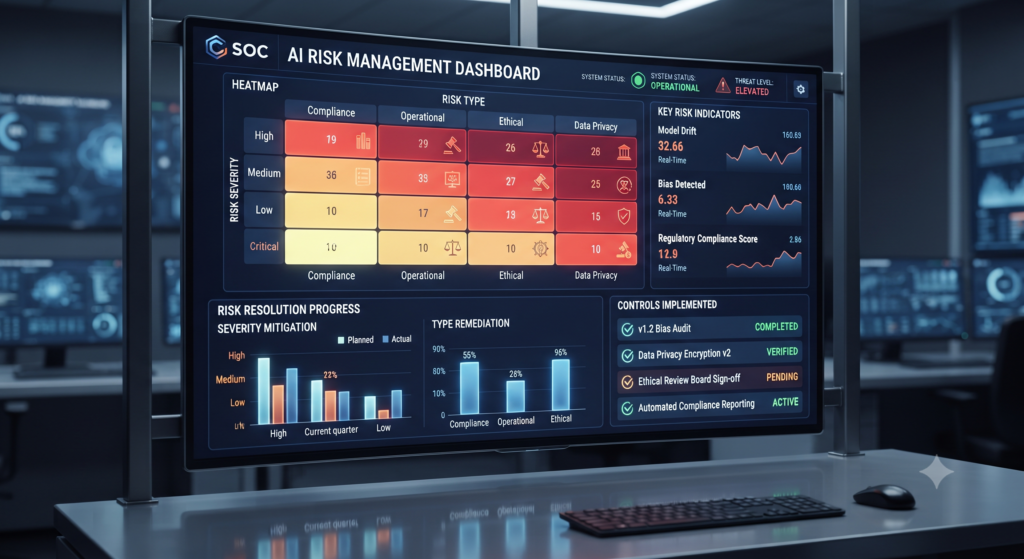
Every AI system introduces risk. Some risks involve bias and fairness. Others relate to security, privacy, compliance, or operational reliability. Effective governance frameworks help organizations identify AI threats, manage AI risks effectively, and establish controls that reduce exposure. Documentation plays a critical role because risks cannot be managed consistently if they are not clearly recorded and monitored.
Organizations should also implement robust AI governance controls, AI decision-making controls, and approval checkpoints throughout the deployment lifecycle. These controls create layers of protection that reduce errors and strengthen accountability. Like seatbelts in a vehicle, governance controls may seem unnecessary until they prevent a serious problem.

Common AI Risk Categories
| Risk Type | Example |
| Compliance Risk | Regulatory violations |
| Operational Risk | System failures |
| Security Risk | Unauthorized access |
| Ethical Risk | Bias and discrimination |
| Reputational Risk | Loss of customer trust |
| Data Risk | Poor data quality |
Integrating Data Governance Into AI Business Operations
AI systems depend on data. Poor-quality data produces unreliable outcomes regardless of how advanced the technology appears. For this reason, governance and data management are inseparable. Effective organizations establish clear ownership, access controls, quality standards, and retention policies. These practices strengthen both operational performance and regulatory compliance.
Businesses that integrate governance and data management can better secure AI applications, improve decision quality, and maintain stakeholder confidence. Data governance also supports AI deployment governance by ensuring systems rely on accurate and trustworthy information. Without strong data foundations, AI initiatives often become expensive experiments rather than reliable business assets.
Monitoring AI Systems and Maintaining Governance Standards
Governance does not end after deployment. AI systems require continuous monitoring because performance can change over time. Organizations must monitor AI systems continuously, review outputs, and evaluate emerging risks. Effective monitoring programs identify issues before they become major operational problems while supporting ongoing compliance requirements.
Regular reviews also help organizations track AI performance metrics, evaluate AI performance, and improve governance maturity. Monitoring reports, audits, and scorecards provide valuable insights that support decision-making. Businesses that prioritize continuous oversight often achieve stronger outcomes because governance becomes an ongoing process rather than a one-time project.
Governance Performance Metrics
| KPI | Purpose |
| Compliance Rate | Measure adherence |
| Audit Findings | Identify weaknesses |
| Incident Frequency | Monitor operational issues |
| Approval Time | Evaluate efficiency |
| Risk Resolution Rate | Track remediation progress |
| Model Accuracy | Measure performance |
Building a Scalable AI Governance Strategy for Long-Term Business Growth
Long-term success requires a governance strategy that evolves alongside business growth. Organizations should develop AI governance roadmaps, establish measurable objectives, and regularly review governance maturity. A scalable strategy enables businesses to expand AI adoption while maintaining control, accountability, and operational consistency.
Forward-thinking organizations create governance systems that support innovation without sacrificing trust. They strengthen AI oversight processes, maintain transparent AI systems, and continue improving governance capabilities as technology advances. The result is an environment where AI contributes to sustainable growth while supporting ethical and responsible business practices.
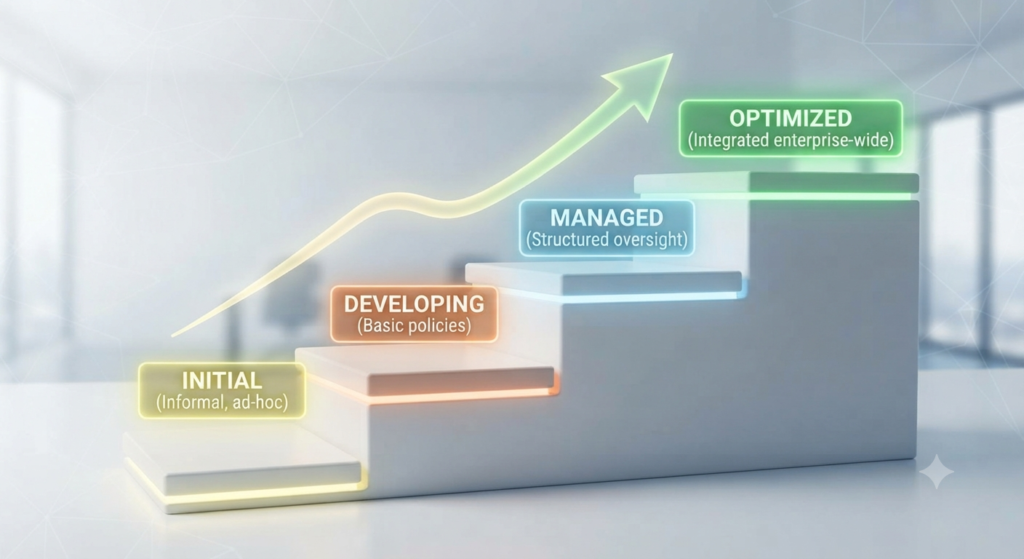
AI Governance Maturity Model
| Stage | Characteristics |
| Initial | Informal governance |
| Developing | Basic policies established |
| Managed | Structured oversight |
| Advanced | Continuous monitoring |
| Optimized | Governance integrated across enterprise |
Conclusion
As AI becomes deeply embedded in business operations, governance becomes a strategic necessity rather than a compliance exercise. Effective ai governance business documents provide the structure needed to manage risks, improve accountability, and support responsible innovation. They transform governance from an abstract concept into practical operational guidance.
Organizations that invest in artificial intelligence governance, AI risk management, AI compliance management, and continuous oversight position themselves for long-term success. By building strong governance frameworks, documenting responsibilities, and monitoring performance consistently, businesses can deploy AI confidently while maintaining trust, transparency, and sustainable growth.
Pingback: AI Governance & Human Oversight
Pingback: AI Governance for Strategic Visibility and Growth