
AI Contextual Governance Solution: The Complete Enterprise Guide
AI contextual governance solutions are becoming essential as organizations adopt Artificial Intelligence (AI) across daily operations. An AI contextual governance solution helps you manage AI systems based on business context instead of static rules. Unlike traditional governance, an AI contextual governance solution understands how AI is used, who uses it, what data it processes, and what risks exist at every stage. As enterprises deploy more AI models, an AI contextual governance solution becomes the foundation for safe innovation, stronger compliance, and responsible decision-making. Today, an AI contextual governance solution is no longer optional because regulations, security threats, and customer expectations continue to evolve.
Whether you work in healthcare, banking, manufacturing, or government, AI creates opportunities alongside new risks. AI models can access sensitive information, generate inaccurate responses, or violate regulatory requirements if left unchecked. That is why organizations are investing in AI Governance, AI Compliance, Responsible AI, and Enterprise AI strategies that adapt to changing business environments. This guide explains how contextual governance works, why traditional governance is no longer enough, and how your organization can implement a practical governance framework that supports innovation without sacrificing security.
What Is an AI Contextual Governance Solution?
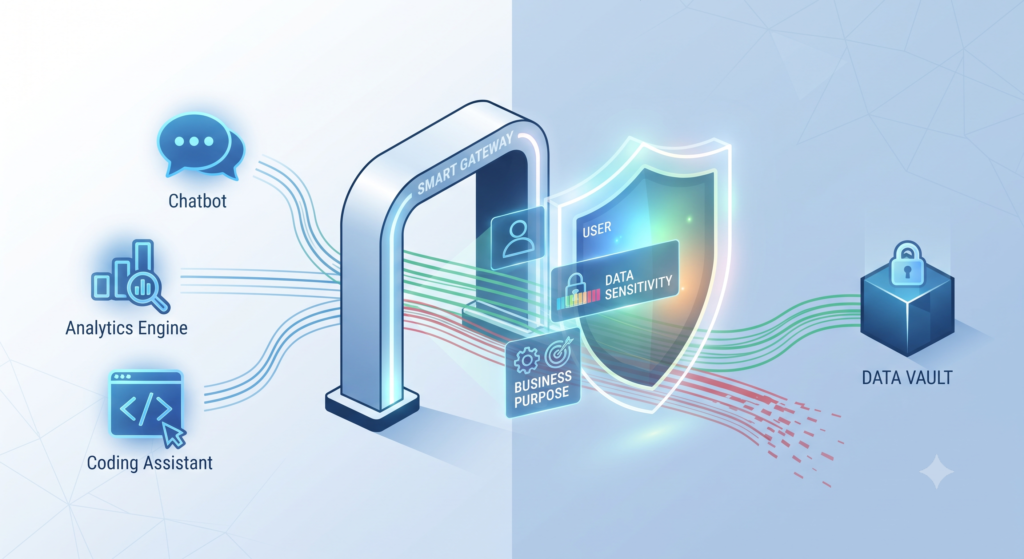
An AI contextual governance solution is a governance system that evaluates every AI interaction using real-time business information instead of relying on fixed compliance rules. It combines Contextual AI Governance, AI Governance Framework, AI Lifecycle Management, and AI Policy Management to understand the purpose of each AI request before allowing or restricting it. This approach protects sensitive information while giving employees the flexibility to use AI responsibly. Instead of asking only, “Is this action allowed?” contextual governance also asks, “Who is performing it, what data is involved, and what business objective does it support?”
You can think of it like an experienced security guard rather than a locked door. A locked door treats everyone the same. An experienced guard recognizes employees, visitors, delivery workers, and emergency responders before deciding what level of access each person needs. In the same way, Context-aware governance gives AI systems the intelligence to make safer governance decisions through AI Oversight, AI Transparency, AI Decision-Making, and continuous AI Monitoring.

How Context-Aware AI Governance Works
Modern enterprises rarely rely on a single AI application. They operate chatbots, recommendation engines, document assistants, coding copilots, and predictive analytics simultaneously. An AI governance solution collects contextual signals from users, AI models, applications, data sources, and regulatory policies before evaluating potential risks. This creates Strategic visibility across the enterprise while supporting Business context, Governance workflows, and Continuous AI monitoring.
For example, a customer support employee asking AI to summarize a public product manual presents little risk. However, if the same employee uploads confidential customer records containing Personally Identifiable Information (PII), the governance engine immediately recognizes the higher sensitivity level. It activates AI Controls, masks sensitive fields, applies AI Policy Enforcement, and records the action for future AI Audit purposes.
AI Contextual Governance vs Traditional AI Governance
| Traditional AI Governance | AI Contextual Governance Solution |
| Static policies | Dynamic context-aware policies |
| Manual compliance reviews | Automated governance decisions |
| Periodic monitoring | Continuous AI Monitoring |
| Limited business visibility | Complete Enterprise AI visibility |
| Reactive risk management | Proactive AI Risk Management |
| Fixed controls | Adaptive Governance automation |
Traditional governance often focuses only on compliance checklists. Contextual governance continuously evaluates changing environments, making it more suitable for today’s rapidly evolving AI landscape.
Why Traditional AI Compliance and Governance Models Fall Short
Traditional governance models were originally designed for predictable software systems. Modern AI behaves differently because Machine Learning, Foundation Models, and generative AI continuously produce new outputs based on changing prompts and data. A fixed compliance checklist cannot anticipate every possible scenario. Organizations therefore struggle to maintain AI Compliance, AI Governance Strategy, and AI Governance Framework as AI systems become more autonomous.
The challenge grows as employees adopt external AI tools without approval. This phenomenon, often called Shadow AI, creates blind spots across the organization. Employees may unknowingly expose confidential documents, intellectual property, or customer information to unauthorized AI services. Without contextual governance, security teams often discover these issues only after a compliance incident or data breach has already occurred.
The Growing Complexity of Enterprise AI
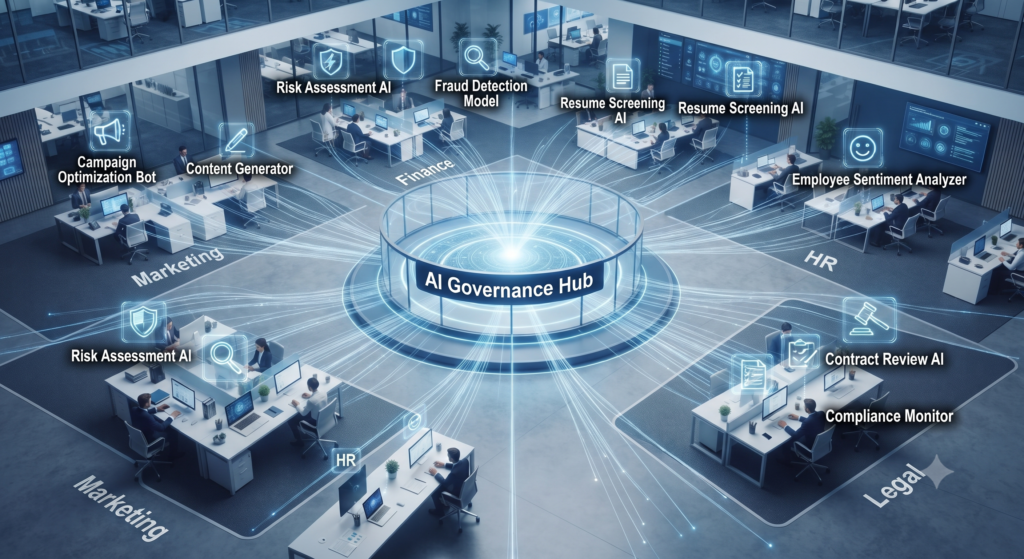
Large enterprises may operate hundreds of AI models across departments. Marketing teams use AI to create campaigns. Finance teams automate reporting. HR departments screen resumes. Legal teams summarize contracts. Each department introduces unique governance requirements. Managing every model manually becomes almost impossible without an integrated AI Governance Platform that supports Model governance, AI Governance Architecture, and centralized Model inventory.
The rapid growth of Prompt Engineering introduces another layer of complexity. Employees interact with AI differently every day. Some prompts are harmless while others unintentionally expose confidential business information. Organizations therefore require intelligent governance systems capable of understanding prompt context instead of relying solely on keyword filtering.
Risks Organizations Face Without Contextual Governance
Without an AI contextual governance solution, organizations expose themselves to multiple operational and regulatory risks. Prompt Injection attacks can manipulate AI responses, while Hallucinations may generate inaccurate recommendations that influence important business decisions. At the same time, Model Drift gradually reduces prediction accuracy as business conditions change. These risks affect trust, compliance, and customer confidence.
Regulators also expect organizations to demonstrate accountability. Companies must increasingly provide evidence through AI Audit Trail, Compliance Readiness, Regulatory Reporting, and Risk-based AI Governance practices. Traditional governance often lacks the automation required to produce these records consistently. Contextual governance closes this gap by documenting AI activity continuously throughout the AI lifecycle.
Core Capabilities of an AI Contextual Governance Solution
An effective AI contextual governance solution combines security, compliance, transparency, automation, and operational oversight into a unified platform. Rather than managing each governance function independently, modern platforms integrate AI Governance Software, AI Operational Governance, AI Monitoring Solution, and AI Governance Lifecycle into one continuous process. This creates stronger governance while reducing administrative overhead.
These capabilities also improve collaboration between IT, security, compliance, legal, and executive leadership. Instead of working from disconnected systems, every stakeholder gains access to shared governance insights, allowing faster decisions and better organizational alignment.
Real-Time Data Lineage and Contextual Tracking
Every AI decision begins with data. Understanding where data originates, how it moves, and which models consume it is essential for responsible governance. Data Lineage, AI Asset Inventory, Model Inventory, and AI Model Registry provide complete visibility into enterprise AI assets. This transparency helps organizations identify dependencies before risks spread throughout business operations.
Suppose an insurance company updates customer information within its claims system. Real-time lineage immediately identifies every downstream AI model using that information. Governance teams can verify compliance, assess business impact, and maintain accurate AI Deployment records without manually tracing data flows. This improves Contextual Intelligence while strengthening enterprise governance.
Policy Enforcement and Prompt Guardrails
Policies become valuable only when they are consistently enforced. Modern governance platforms automate AI Policy Management, Prompt Guardrails, and Governance Controls by evaluating prompts before they reach AI models. These controls reduce accidental data exposure while allowing employees to remain productive.
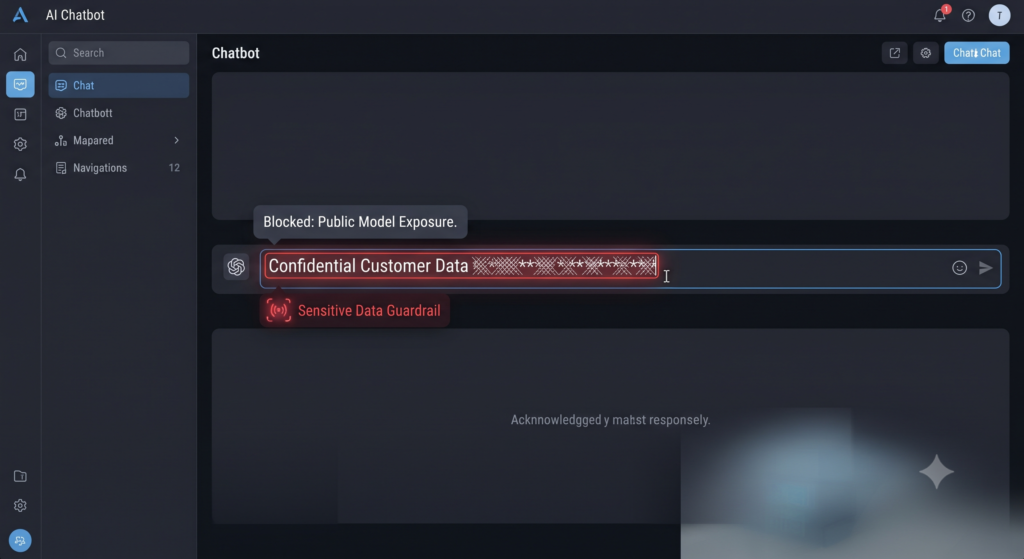
Imagine a financial analyst attempting to upload confidential merger documents into an external AI chatbot. Context-aware policies instantly recognize sensitive business information, apply Zero Trust principles, block unauthorized access, and recommend approved enterprise AI tools instead. This balance between productivity and protection defines effective AI Security Governance.
Privacy Protection and Data Minimization
Privacy regulations continue to expand across industries. Organizations therefore need governance systems that automatically enforce Privacy by Design, Data Protection, and Data Minimization principles throughout every AI interaction. Sensitive information should only be processed when absolutely necessary.
Healthcare organizations offer a useful example. Medical AI systems frequently process Protected Health Information (PHI) alongside Personally Identifiable Information (PII). Contextual governance automatically applies Data Classification, limits unnecessary data sharing, strengthens Access Control, supports Identity Governance, and evaluates Vendor Risk Management before allowing AI services to process sensitive healthcare records. This proactive approach improves patient privacy while simplifying regulatory compliance.
Key Components of an Effective AI Contextual Governance Framework
Building an effective AI contextual governance solution requires more than installing software. Organizations need a structured framework that combines technology, governance policies, executive leadership, and continuous improvement. A mature framework ensures every AI system follows consistent governance principles from development through retirement. This lifecycle approach reduces operational risk while supporting innovation across departments.
Successful organizations also recognize that governance is a business strategy rather than only an IT responsibility. Security teams, compliance officers, legal experts, business leaders, and AI developers must collaborate to establish clear accountability, measurable governance outcomes, and continuous oversight. When governance becomes part of everyday decision-making, AI adoption becomes faster, safer, and easier to scale.
Context-Aware Risk Assessment
Traditional risk assessments evaluate systems at fixed intervals. Modern AI environments change daily, making static reviews insufficient. Context-Aware Risk Assessment continuously analyzes user behavior, business purpose, data sensitivity, and regulatory obligations before calculating risk. By combining AI Risk Assessment, Contextual Risk Engine, AI Risk Scoring, and AI Risk Heatmap, organizations gain a real-time view of their AI exposure.
Continuous assessment also supports Algorithmic Impact Assessment and broader Governance Metrics, allowing leadership to prioritize high-risk AI systems before they create H3: Adaptive AI Policies and Automated Controls
Static governance rules quickly become outdated because AI systems, regulations, and business priorities constantly evolve. Adaptive Governance allows policies to change automatically based on risk, user roles, business context, and regulatory updates. Instead of manually updating hundreds of governance rules, organizations can rely on Governance Automation, AI Governance Software, and an intelligent AI Governance Platform to enforce consistent controls across every AI application.
For example, an employee in the finance department may have permission to use AI for forecasting but not for uploading confidential acquisition documents to a public chatbot. The governance platform recognizes the context, applies AI Operational Governance, activates the correct AI Monitoring Solution, and either allows, limits, or blocks the request. This dynamic approach protects sensitive data without slowing daily operations.
Human-in-the-Loop Oversight
AI can automate repetitive work, yet important business decisions still require human judgment. Human-in-the-loop (HITL) keeps experienced professionals involved whenever AI handles sensitive information or high-impact decisions. Human reviewers verify AI recommendations before action is taken, reducing errors and improving accountability.
This approach also strengthens AI Explainability, Explainable AI (XAI), AI Accountability, and AI Transparency. Decision-makers can understand why an AI model reached a conclusion instead of accepting a “black box” answer. As a result, executives gain greater confidence in AI Decision-Making, while governance teams demonstrate stronger Corporate Governance during audits.
Step-by-Step Framework for Implementing AI Contextual Governance
Implementing an AI contextual governance solution does not require replacing every existing system. Most organizations achieve better results by introducing governance gradually. A phased implementation reduces disruption while allowing teams to improve policies as AI adoption grows. The framework should align governance with business objectives, security requirements, and regulatory obligations from the beginning.
Successful implementation also depends on collaboration. IT, compliance, security, legal, and business leaders should share responsibility for governance decisions instead of working independently. This shared ownership creates stronger oversight and encourages responsible AI adoption across the enterprise.
Inventory and Classify AI Systems
You cannot govern AI that you cannot see. The first step is creating a complete AI Asset Inventory that documents every AI application, model, data source, and vendor operating inside the organization. A comprehensive Model Inventory helps identify duplicate systems, unsupported applications, and hidden AI Infrastructure before they become security risks.
After inventory, organizations should classify AI systems according to business value, regulatory exposure, and data sensitivity. This process supports AI Lifecycle Governance, improves Data Classification, and ensures governance resources focus on the highest-risk AI deployments first.
Deploy Continuous Monitoring and Explainability
AI models evolve over time. Performance that appears accurate today may gradually decline because of changing customer behavior, new regulations, or updated business processes. Continuous Model Monitoring and AI Monitoring detect these changes early before they affect operations or compliance.
Organizations should also combine monitoring with Explainability to understand how AI produces recommendations. Together, Compliance Monitoring, AI Audit, and a detailed AI Audit Trail create complete visibility into AI performance. This transparency simplifies regulatory reviews while improving trust among employees, customers, and business leaders.
Integrate Governance with Existing Security and Compliance Workflows
Governance becomes more effective when it connects with existing enterprise systems instead of operating separately. Organizations should integrate AI governance into Enterprise Risk Management, existing Governance Workflows, and security operations. This approach eliminates duplicate work while providing a unified view of enterprise risk.
Integration also strengthens Security Monitoring, Security Controls, Identity Governance, and Privileged Access management. Combined with automated Regulatory Reporting, governance data flows directly into existing GRC and security platforms, allowing organizations to respond to risks faster while maintaining consistent compliance across the business.
Best Practices for Continuous AI Monitoring and Regulatory Compliance
Strong governance is an ongoing process rather than a one-time project. Organizations should regularly review governance policies, monitor AI performance, and adapt controls as technology evolves. Continuous improvement ensures governance remains effective despite changing business environments and expanding AI regulations.
Industry leaders also measure governance maturity over time instead of focusing only on compliance. Regular assessments reveal gaps, identify improvement opportunities, and demonstrate accountability to executives, customers, and regulators.
| Best Practice | Business Benefit |
| Build a clear AI Governance Strategy | Consistent governance across departments |
| Maintain comprehensive AI Audit Trail | Faster regulatory reporting |
| Automate Compliance Monitoring | Reduced manual effort |
| Perform regular AI Risk Assessment | Earlier identification of emerging risks |
| Improve AI Transparency with Explainable AI (XAI) | Greater stakeholder trust |
| Use executive governance dashboards | Better strategic decisions |
| Measure AI Governance Maturity | Continuous improvement |
“Responsible AI is not about limiting innovation. It is about ensuring innovation earns lasting trust.”

Business Benefits of AI Contextual Governance Across Industries
An AI contextual governance solution delivers measurable value beyond regulatory compliance. It improves operational efficiency, reduces security risks, and supports confident AI adoption. Organizations gain better visibility into AI assets while ensuring governance keeps pace with innovation.
Business leaders also benefit from improved Business Intelligence, stronger Strategic Decision-Making, and higher organizational trust. Governance becomes a competitive advantage because employees can innovate confidently without creating unnecessary compliance risks.
| Industry | Key Business Benefits |
| Financial Services and Banking AI | Fraud prevention, regulatory compliance, stronger risk controls |
| Healthcare AI | Better patient privacy, secure AI diagnostics, HIPAA compliance |
| Insurance | Faster claims processing with improved governance |
| Government AI | Transparent public services and accountable AI decisions |
| HR Technology | Fair hiring practices and bias reduction |
| Manufacturing AI | Predictive maintenance and operational efficiency |
| Customer Service AI | Better customer experiences with safer AI interactions |
| Legal AI | Secure document review and improved compliance |
Mini Case Study
A multinational financial institution deployed an enterprise AI Governance Platform after discovering employees were using multiple public AI tools without oversight. Within six months, the organization established centralized governance, reduced unauthorized AI usage by more than 60%, improved audit readiness, and accelerated AI project approvals because governance became automated instead of manual. The result was lower operational risk alongside faster digital transformation.
Future Trends in AI Contextual Governance Solutions
AI governance will become increasingly intelligent over the next few years. Instead of relying on predefined rules, governance platforms will predict risks before they occur using advanced Contextual Intelligence, automated reasoning, and real-time business awareness. Organizations will shift from reactive compliance to proactive governance.
Future platforms will also support autonomous governance, real-time executive dashboards, and governance embedded across the entire AI lifecycle. As AI Regulations continue to evolve, enterprises with mature AI Governance Architecture, intelligent AI Policy Engine, and comprehensive Enterprise AI Visibility will adapt faster while maintaining compliance and customer trust.
Frequently Asked Questions About AI Contextual Governance Solutions
What is an AI contextual governance solution?
An AI contextual governance solution is a governance platform that evaluates AI activity using business context, user identity, data sensitivity, and regulatory requirements to improve security, compliance, and responsible AI usage.
Why is contextual AI governance important?
It helps organizations manage changing AI risks, improve compliance, protect sensitive information, and make governance decisions based on real-world business conditions instead of static rules.
How is contextual governance different from traditional AI governance?
Traditional governance applies fixed policies to every situation. Context-aware AI evaluates each interaction individually, allowing more accurate, adaptive, and risk-aware governance decisions.
Which industries benefit the most?
Highly regulated industries such as healthcare, banking, insurance, government, legal services, manufacturing, and enterprise software gain significant benefits because they process sensitive data and face strict compliance requirements.
How does contextual governance improve AI compliance?
It continuously enforces policies, records governance activities, automates monitoring, and generates audit evidence, making regulatory compliance easier and more reliable.
What role does Explainable AI play?
Explainable AI (XAI) improves transparency by helping users understand how AI models reach decisions. This strengthens trust, accountability, and regulatory readiness.
How does it support Zero Trust security?
Contextual governance applies Zero Trust principles by verifying every AI request according to user identity, device, data sensitivity, and business purpose before granting access.
What are prompt guardrails?
Prompt Guardrails automatically inspect prompts before they reach AI models. They prevent sensitive information from being exposed while reducing risks such as prompt injection and data leakage.
How should organizations begin implementation?
Start by creating an AI inventory, classifying AI systems, deploying continuous monitoring, integrating governance into existing security processes, and regularly reviewing governance performance.
What features should businesses look for?
Look for capabilities such as AI Risk Management, AI Monitoring, AI Policy Management, AI Audit, Governance Automation, Model Monitoring, AI Lifecycle Management, and comprehensive reporting dashboards.
Conclusion
An AI contextual governance solution has become the foundation of responsible enterprise AI. As organizations deploy more intelligent systems, traditional governance methods can no longer keep pace with changing risks, evolving regulations, and increasingly complex AI ecosystems. Context-aware governance provides the visibility, automation, and flexibility needed to manage AI confidently across its entire lifecycle.
Organizations that invest in Responsible AI, AI Governance, AI Compliance, AI Risk Management, and continuous oversight today will be better prepared for tomorrow’s regulatory landscape. More importantly, they will build trust with customers, employees, and regulators while unlocking the full business value of artificial intelligence through secure, transparent, and accountable innovation.
operational or compliance issues.