
Essential AI Marketing Glossary & Terminology
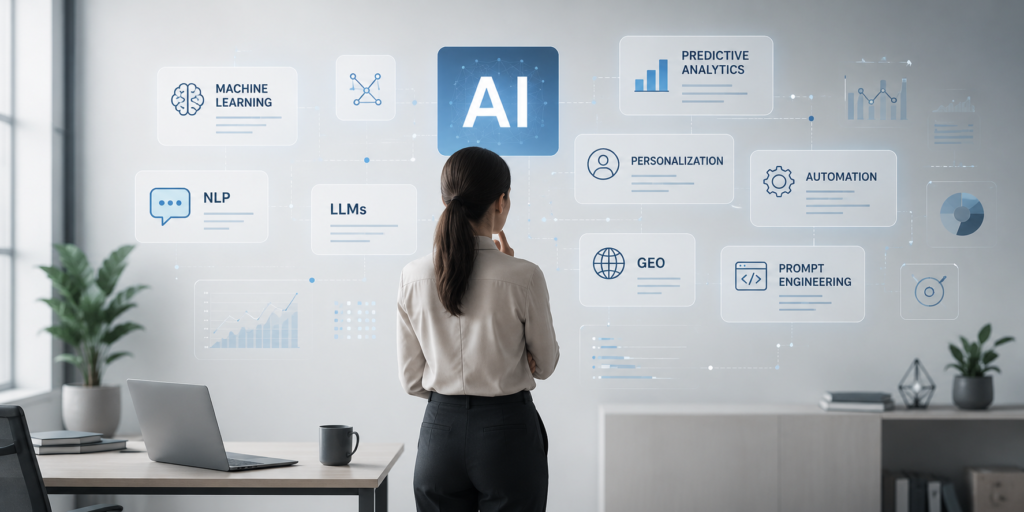
Introduction to AI Marketing glossary and terminology
Today understanding AI marketing glossary and terminology is no longer optional. Whether you work in SEO, content marketing, paid advertising, email marketing, or customer experience, knowing the language of AI helps you make informed decisions and stay competitive.
Imagine you are sitting in a marketing meeting and someone says, “Our LLM optimization needs to align with the DCO workflow.” Would you immediately know what they mean?
A lack of knowledge about Essential AI marketing glossary and terminology can become expensive. Misunderstanding a vendor presentation, choosing the wrong AI platform, or investing in technology that does not fit your business goals can waste both time and marketing budgets. Understanding AI marketing glossary and terminology helps marketers evaluate AI tools with confidence, communicate more effectively with technical teams, and develop smarter digital marketing strategies.
This guide has been created for marketers—not software engineers. Every definition is explained in simple English with practical examples that show how each technology is used in real marketing campaigns. Instead of complicated technical explanations, you will learn how AI concepts improve content marketing, customer experience, marketing automation, search engine optimization, and business growth.
As AI continues to transform digital marketing, professionals who understand AI marketing glossary and terminology will be better prepared to improve campaign performance, optimize customer journeys, increase conversions, and adapt to future innovations. Consider this glossary your go-to reference whenever you encounter a new AI marketing term.
Core Concepts of Artificial Intelligence in Marketing glossary
Before using any AI-powered software, you should understand the basic concepts behind it. Many people mistakenly use Artificial Intelligence (AI), Machine Learning (ML), and Deep Learning as if they mean the same thing. In reality, they describe different technologies that work together to create intelligent marketing systems.
Learning these core concepts provides the foundation for mastering AI marketing glossary and terminology. Once you understand these basics, every advanced AI marketing strategy becomes much easier to understand.
Artificial Intelligence (AI)
Artificial Intelligence (AI) is the broad field of computer science that enables machines to perform tasks requiring human intelligence. These tasks include learning, reasoning, recognizing patterns, making predictions, solving problems, and understanding language. Understanding AI is one of the first concepts covered in any Essential AI Marketing Glossary & Terminology because it forms the foundation of every AI-powered marketing technology.
In digital marketing, AI powers recommendation engines, personalized email campaigns, customer segmentation, fraud detection, content generation, and advertising optimization. Every time Netflix recommends a movie or an online store suggests products based on your browsing history, AI is working behind the scenes. As you explore an Essential AI Marketing Glossary & Terminology, you’ll discover how AI supports smarter decision-making, improves customer experiences, and helps marketers automate repetitive tasks while delivering more personalized campaigns.
Think of AI as the engine powering modern digital marketing. You may not always notice it, but it influences nearly every interaction customers have with brands.
“AI is not going to replace marketers. Marketers using AI will replace marketers who don’t.” — Paul Roetzer
Machine Learning (ML)
Machine Learning (ML) is a branch of AI that allows computers to learn from data without requiring manual programming for every decision.
Instead of relying on fixed rules, machine learning systems analyze historical information, recognize patterns, and continuously improve their predictions.
Marketing teams use machine learning for:
- Predicting customer purchases
- Email send-time optimization
- Product recommendations
- Lead scoring
- Audience segmentation
- Conversion prediction
For example, your email marketing platform may discover that one subscriber usually opens emails at 8 AM while another responds better during the evening. Machine learning automatically adjusts delivery times to improve engagement.
The more quality data these systems receive, the smarter they become.

Deep Learning (DL)
Deep Learning is an advanced form of machine learning that uses multiple layers of artificial neural networks to process highly complex information.
Unlike traditional machine learning, deep learning can understand images, videos, voice recordings, and natural language with remarkable accuracy.
Marketing applications include:
- Voice assistants
- Image recognition
- Visual search
- Speech recognition
- Product recommendations
- Customer behavior prediction
For marketers, deep learning creates highly personalized customer experiences by analyzing enormous amounts of behavioral data in real time.
Algorithms and AI Models
An algorithm is a sequence of instructions designed to solve a problem.
An AI model is created after training an algorithm using large datasets.
Together they power many modern marketing applications, including:
- Campaign optimization
- Budget allocation
- Audience targeting
- Customer lifetime value prediction
- Dynamic pricing
- Marketing automation
Understanding algorithms and AI models is another important step in mastering AI marketing glossary and terminology, because nearly every AI marketing platform depends on them.
| Term | Simple Definition | Marketing Example |
| Artificial Intelligence | Machines performing human-like tasks | Customer personalization |
| Machine Learning | AI learning from data | Email optimization |
| Deep Learning | Neural networks learning complex patterns | Image recognition |
| Algorithm | Rules for solving problems | Budget optimization |
| AI Model | Algorithm trained using data | Product recommendations |
Data Foundations in AI Marketing
Every AI system depends on data. Even the most advanced AI cannot make intelligent decisions if the information it receives is incomplete, inaccurate, or outdated.
One of the biggest reasons AI projects fail is poor data quality rather than poor technology. Understanding data management is therefore an essential part of learning AI marketing glossary and terminology.
Data Mining
Data Mining is the process of analyzing large datasets to identify hidden patterns, trends, and valuable business insights.
Businesses use data mining to answer questions like:
- Which customers are most likely to buy?
- Which marketing campaigns generate the highest ROI?
- Which products are frequently purchased together?
Instead of relying on guesswork, marketers use data mining to make evidence-based decisions.
Structured and Unstructured Data
Marketing data generally falls into two categories.
Structured data includes organized information stored in databases, CRM systems, spreadsheets, and transaction records.
Unstructured data includes customer reviews, emails, videos, images, social media posts, audio recordings, and chat conversations.
More than 80% of business data is unstructured. Fortunately, Artificial Intelligence (AI) can process both types, giving marketers deeper insights into customer behavior.
Data Pipelines
A data pipeline automatically collects, cleans, transforms, and transfers information between different systems.
Think of it as the transportation network for your marketing data.
Without reliable data pipelines, AI tools receive incomplete information, leading to poor predictions and inaccurate recommendations.
Strong data pipelines ensure marketing dashboards, CRM systems, analytics platforms, and AI applications all work together seamlessly.
Data Governance and Cleaning
Data Governance establishes the policies that control how organizations collect, store, protect, and use customer information.
Data Cleaning removes duplicate records, fixes inconsistencies, and corrects errors before data enters AI systems.
The famous principle still applies:
Garbage in, garbage out.
No matter how advanced your AI platform is, it cannot deliver reliable insights if the underlying data is inaccurate.
Clean, well-governed data creates better personalization, more accurate forecasts, and stronger marketing performance.
Natural Language Processing (NLP) and Language AI
Marketing is built on communication. Customers search online, ask questions, leave reviews, send emails, and interact with brands using natural language.
For AI to become useful, it must understand not only words but also meaning, context, and customer intent.
That is where Natural Language Processing (NLP) becomes essential. Understanding these language technologies is a major part of AI marketing glossary and terminology because they power today’s most popular AI tools, including chatbots, AI writing assistants, search engines, and virtual assistants.
Natural Language Processing (NLP)
Natural Language Processing (NLP) is the branch of Artificial Intelligence (AI) that enables computers to understand, interpret, and generate human language. It combines Machine Learning (ML), linguistics, and data analysis so AI systems can process text and speech much like humans do.
In marketing, NLP powers chatbots, sentiment analysis, keyword clustering, AI writing assistants, voice search, and customer feedback analysis. Instead of manually reading thousands of customer reviews, marketers can use NLP tools to identify common complaints, popular product features, and buying intent within minutes.
For example, an online retailer can analyze thousands of product reviews using NLP to discover that customers consistently praise fast delivery but complain about complicated returns. These insights help businesses improve customer satisfaction and marketing messaging.
Large Language Models (LLMs)
Large Language Models (LLMs) are advanced AI systems trained on billions of words collected from books, websites, articles, and other public sources. They understand context, answer questions, summarize information, translate languages, and generate human-like content.
Popular examples include ChatGPT, Claude, and Gemini.
LLMs are transforming digital marketing by helping professionals create blog posts, email campaigns, landing pages, ad copy, product descriptions, and social media content much faster than traditional writing methods.
However, marketers should remember that LLMs can sometimes generate inaccurate information, commonly known as AI hallucinations. Always verify facts before publishing AI-generated content.
Learning how LLMs work is becoming one of the most valuable parts of understanding AI marketing glossary and terminology because these models are changing content creation, SEO, and customer communication.
Generative AI (GenAI)
Generative AI creates entirely new content instead of simply analyzing existing information. It can generate articles, images, videos, presentations, code, music, and even voice recordings.
Businesses use Generative AI for:
- Content marketing
- Social media posts
- Email campaigns
- Advertising copy
- Product descriptions
- Creative brainstorming
Rather than replacing marketers, Generative AI increases productivity by handling repetitive drafting tasks. Human creativity, editing, and strategic thinking are still essential for producing high-quality marketing content.
Chatbots and Conversational AI
A chatbot is an AI-powered application designed to answer customer questions automatically.
Conversational AI goes beyond simple scripted responses. It understands context, remembers previous interactions, and provides more natural conversations.
Businesses use conversational AI to:
- Provide 24/7 customer support
- Answer product questions
- Generate leads
- Schedule appointments
- Recommend products
- Improve customer satisfaction
Modern conversational AI reduces support costs while delivering faster customer service, making it an important concept within AI marketing glossary and terminology.

Predictive and Analytical AI in Marketing
One of the greatest advantages of AI is its ability to identify patterns and predict future outcomes. Instead of reacting after customers leave or campaigns fail, marketers can use AI to anticipate behavior and take action before problems occur.
Understanding predictive technologies is another essential part of AI marketing glossary and terminology because data-driven forecasting improves marketing performance and return on investment.
Predictive Analytics
Predictive Analytics combines historical data with Machine Learning (ML) to forecast future customer behavior.
Marketing teams use predictive analytics to estimate:
- Purchase probability
- Customer churn
- Campaign performance
- Lead quality
- Sales forecasting
- Customer lifetime value
For example, a subscription company can identify customers likely to cancel their memberships and automatically send personalized retention offers before they leave.
Sentiment Analysis
Sentiment Analysis uses Natural Language Processing (NLP) to determine whether customer opinions are positive, negative, or neutral.
Brands monitor:
- Product reviews
- Social media conversations
- Customer surveys
- Online forums
- Support tickets
Instead of reading thousands of comments manually, AI identifies customer emotions instantly, allowing businesses to respond before negative feedback damages their reputation.
Customer Behavior Modeling
Customer behavior modeling analyzes browsing history, purchase patterns, engagement levels, and customer interactions to predict future actions.
Instead of relying only on age or location, AI groups customers according to actual behavior.
This allows businesses to deliver more relevant product recommendations, personalized offers, and targeted advertising.
Marketing Forecasting
AI-powered marketing forecasting helps businesses estimate future sales, advertising performance, customer demand, and seasonal trends.
Using predictive models enables marketers to allocate budgets more effectively, optimize campaigns earlier, and reduce unnecessary spending.
Forecasting replaces guesswork with evidence-based decision making.
Computer Vision and Automation in Marketing
Marketing is no longer limited to text. Every day, businesses create and manage millions of images and videos.
Computer Vision enables AI to understand visual content just as Natural Language Processing (NLP) helps AI understand language.
Visual AI is becoming an increasingly important topic within AI marketing glossary and terminology.
Computer Vision
Computer Vision allows AI systems to recognize and analyze images and videos.
Marketing applications include:
- Logo recognition
- Product detection
- Visual search
- Social media monitoring
- Image categorization
- Quality inspection
Brands can automatically identify where their products appear online without manually reviewing thousands of photos.

Optical Character Recognition (OCR)
Optical Character Recognition (OCR) converts printed or handwritten text inside images into editable digital text.
Marketing teams use OCR to digitize printed documents, invoices, customer forms, advertisements, and receipts for analysis.
OCR saves significant time by eliminating manual data entry.
Image Recognition
Image Recognition identifies people, products, objects, locations, and activities within photographs.
Popular visual search platforms allow customers to upload a product image instead of typing search queries.
Optimizing product images for AI-powered visual search is becoming increasingly important for ecommerce businesses.
Marketing Automation Systems
Marketing Automation combines AI with customer data to automate repetitive marketing activities.
Instead of sending identical messages to every customer, AI determines:
- The right customer
- The right message
- The right channel
- The right time
Automation improves efficiency while increasing engagement and conversion rates.
AI Personalization and Customer Experience
Today’s customers expect personalized experiences rather than generic marketing messages.
Modern AI makes personalization possible by analyzing customer behavior in real time and adapting experiences accordingly.
Understanding personalization technologies is another valuable part of AI marketing glossary and terminology because they directly influence customer satisfaction and business growth.
Personalization Engines
A personalization engine analyzes customer information such as:
- Purchase history
- Browsing behavior
- Device type
- Location
- Preferences
- Previous interactions
It then recommends products, displays customized content, and personalizes marketing messages for each individual user.
Dynamic Creative Optimization (DCO)
Dynamic Creative Optimization (DCO) automatically creates personalized advertisements by combining different headlines, images, offers, and calls-to-action based on customer behavior.
Instead of producing one advertisement for everyone, DCO generates thousands of customized versions, improving click-through and conversion rates.
Recommendation Systems
Recommendation systems suggest products, services, articles, or videos based on previous customer activity.
These systems increase:
- Average order value
- Customer retention
- Engagement
- Cross-selling
- Upselling
Recommendation engines are widely used by ecommerce websites, streaming platforms, and online marketplaces.
Customer Journey Mapping with AI
AI continuously tracks how customers interact with a business across websites, email campaigns, social media, paid advertisements, and mobile apps.
Instead of relying on static journey maps, marketers receive real-time insights into customer behavior, helping optimize every stage of the buying journey.
Understanding these personalization technologies further strengthens your knowledge of AI marketing glossary and terminology and prepares you for the advanced optimization strategies covered next.

Advanced AI Marketing Strategies and Optimization
Artificial intelligence is changing the way brands approach SEO, content marketing, customer acquisition, and campaign optimization. Understanding these advanced concepts is essential because they represent the future of digital marketing. As search engines continue integrating AI into their platforms, marketers who understand AI marketing glossary and terminology will be better prepared to compete in an AI-driven search environment.
Prompt Engineering
Prompt Engineering is the practice of writing clear and detailed instructions that help AI systems generate accurate, useful, and relevant outputs.
A well-written prompt can dramatically improve the quality of AI-generated blog posts, email campaigns, social media captions, product descriptions, and advertising copy. Instead of asking AI to “write a blog,” experienced marketers provide context, audience information, tone, structure, keywords, and objectives.
Prompt engineering is quickly becoming one of the most valuable skills for content creators because better prompts produce better results while reducing editing time.
AI SEO / AEO / GEO
Traditional Search Engine Optimization (SEO) focuses on improving rankings in search engine results pages.
Answer Engine Optimization (AEO) helps content appear in voice assistants, featured snippets, and AI-generated answers.
Generative Engine Optimization (GEO) focuses on making content visible within AI-powered search experiences such as Google AI Overviews and other generative search engines.
Modern marketers should optimize content not only for search rankings but also for AI-generated responses. Creating authoritative, well-structured, and trustworthy content increases the chances of being referenced by AI systems.
LLM Optimization (LLMO)
LLM Optimization (LLMO) is the process of structuring content so Large Language Models (LLMs) can easily understand, summarize, and reference it.
Effective LLM optimization includes:
- Clear headings
- Direct definitions
- Logical content structure
- Accurate information
- Credible sources
- Helpful examples
As AI search becomes more common, LLM optimization is expected to become a core component of every content marketing strategy.
Marketing Orchestration
Marketing Orchestration uses AI to coordinate every customer interaction across multiple channels, including email, social media, SMS, websites, paid advertising, and mobile applications.
Instead of treating each channel separately, AI creates a connected customer experience where every interaction supports the next stage of the buyer’s journey.
Businesses using AI-powered orchestration often improve customer engagement, campaign consistency, and marketing efficiency.
Ethics, Privacy, and Responsible AI Marketing
As AI becomes more powerful, marketers must use it responsibly. Success is not measured only by automation or efficiency but also by fairness, transparency, and customer trust.
Responsible AI is becoming an increasingly important part of AI marketing glossary and terminology because customers expect businesses to use their data ethically.
AI Bias
AI Bias occurs when AI systems produce unfair or inaccurate outcomes because the training data contains historical bias or incomplete information.
In marketing, bias may affect:
- Audience targeting
- Product recommendations
- Hiring decisions
- Advertising delivery
- Customer segmentation
Regular testing and monitoring help reduce bias and improve fairness across AI systems.
Data Privacy (PII Protection)
Personally Identifiable Information (PII) includes names, email addresses, phone numbers, IP addresses, and other information that identifies an individual.
Businesses must comply with privacy regulations while collecting and processing customer information.
Good privacy practices include:
- Collecting only necessary data
- Encrypting sensitive information
- Obtaining user consent
- Explaining how customer data is used
- Allowing users to manage their privacy preferences
Privacy-first marketing builds long-term customer trust.
Transparency in AI Systems
AI transparency means clearly informing customers when AI influences their experience.
Businesses should disclose:
- AI-generated content
- Automated recommendations
- Personalized advertising
- AI-powered customer service
Being transparent increases customer confidence and strengthens brand credibility.
Data Ethics in Marketing
Data ethics focuses on using customer information responsibly.
Ethical marketers ask important questions before collecting or using data:
- Is this information necessary?
- Would customers expect this use?
- Does this create value for customers?
- Is customer privacy protected?
Responsible data practices create stronger customer relationships and sustainable business growth.
Future of AI in Marketing and Key Takeaways
Artificial intelligence continues evolving rapidly. Technologies considered innovative today may become standard marketing tools within just a few years.
Keeping up with AI marketing glossary and terminology allows marketers to adapt more quickly as new technologies emerge.
Emerging AI Marketing Trends
Several AI technologies are expected to shape the future of marketing.
Agentic AI refers to systems capable of completing multiple tasks with minimal human intervention.
Retrieval-Augmented Generation (RAG) combines AI-generated responses with current external information to improve accuracy.
Edge AI processes information directly on local devices instead of cloud servers, enabling faster personalization and better privacy.
Businesses adopting these technologies early may gain significant competitive advantages.
Human + AI Collaboration
Artificial intelligence is designed to enhance marketers—not replace them.
AI handles repetitive activities such as data analysis, drafting content, audience segmentation, and campaign optimization.
Humans continue providing creativity, emotional intelligence, strategic thinking, storytelling, and ethical judgment.
The strongest marketing teams combine human expertise with AI efficiency.
Continuous Learning in AI Marketing
AI evolves constantly.
New tools, optimization methods, and search technologies appear every year.
Marketers should regularly:
- Learn new AI concepts.
- Test emerging AI tools.
- Follow industry developments.
- Update marketing strategies.
- Review changes in AI marketing glossary and terminology.
Continuous learning ensures businesses remain competitive in the rapidly changing digital landscape.
Quick Reference Table: Key AI Marketing glossary and Terms
| Term | Meaning | Marketing Benefit |
| Artificial Intelligence (AI) | Machines performing human-like tasks | Improves automation and decision-making |
| Machine Learning (ML) | AI learning from data | Campaign optimization |
| Natural Language Processing (NLP) | AI understanding language | Chatbots and content analysis |
| Large Language Models (LLMs) | AI trained on massive text datasets | Content generation |
| Generative AI | AI creating original content | Faster content production |
| Predictive Analytics | Forecasting future outcomes | Better planning |
| Dynamic Creative Optimization (DCO) | Personalized advertisements | Higher conversions |
| Prompt Engineering | Writing better AI instructions | Improved AI outputs |
| Generative Engine Optimization (GEO) | Optimizing for AI search | Greater AI visibility |
| LLM Optimization (LLMO) | Structuring content for LLMs | Better AI understanding |
| Agentic AI | Autonomous AI systems | Advanced automation |
FAQ
What is an AI marketing glossary?
An AI marketing glossary is a reference guide that explains important Artificial Intelligence (AI) terms used in digital marketing. Understanding AI marketing glossary and terminology helps marketers confidently use AI technologies in SEO, advertising, content creation, personalization, and analytics.
Why should marketers learn AI marketing terminology?
Learning AI marketing glossary and terminology enables marketers to understand AI-powered tools, improve communication with technical teams, evaluate software solutions, and make better marketing decisions.
What is the difference between AI, Machine Learning, and Deep Learning?
Artificial Intelligence (AI) is the broad field of intelligent machines.
Machine Learning (ML) is a branch of AI where systems learn from data.
Deep Learning is a specialized form of machine learning that uses neural networks to process complex information such as language, images, and speech.
What is Dynamic Creative Optimization (DCO)?
Dynamic Creative Optimization (DCO) automatically creates personalized advertisements by combining headlines, images, and calls-to-action based on customer behavior and preferences.
What is the difference between SEO, AEO, and GEO?
SEO improves rankings in traditional search engines.
AEO optimizes content for AI-generated answers and voice assistants.
GEO improves visibility inside generative search experiences such as AI Overviews.
Conclusion
Artificial intelligence is transforming every aspect of digital marketing, from content creation and customer personalization to SEO, analytics, and automation. As new technologies continue to emerge, understanding AI marketing glossary and terminology is becoming an essential skill for marketers, business owners, and content creators.
By learning the concepts covered in this guide, you can evaluate AI tools with greater confidence, improve marketing performance, communicate more effectively with technical teams, and prepare your business for the future of AI-powered marketing. Keep this guide bookmarked as a reliable reference, continue exploring new AI innovations, and update your knowledge regularly. The marketers who invest in learning today will be the ones leading tomorrow.