
AI business context refinement
Artificial intelligence is transforming the way organizations operate across every industry. From healthcare and banking to retail and manufacturing, AI now supports thousands of business decisions every day. However, intelligent technology alone cannot guarantee successful outcomes. Businesses also need strong AI governance and AI business context refinement to ensure AI systems understand organizational goals, industry regulations, customer expectations, and real-world business conditions.
Today, companies are investing heavily in artificial intelligence governance because technical accuracy alone is no longer enough. AI models must generate recommendations that align with strategic objectives, operational workflows, and compliance requirements. Through AI business context refinement, organizations improve contextual understanding, reduce decision errors, and create AI systems that deliver reliable business value. Effective governance frameworks act as the bridge between innovation and responsible AI adoption, helping businesses build trustworthy AI, transparent AI, and scalable AI solutions that support long-term growth.
Understanding AI Governance Within Modern Business Contexts
Modern organizations increasingly depend on artificial intelligence to automate repetitive work, analyze complex datasets, predict future trends, and support strategic planning. While these capabilities create significant business advantages, AI systems require clear AI governance to operate responsibly. Without proper oversight, even highly advanced AI models can produce inconsistent results or recommendations that conflict with business priorities. This is where AI business context refinement becomes essential for maintaining reliable and accurate AI performance.
AI Governance in Business Context refers to the collection of governance policies, governance standards, monitoring practices, and accountability measures that guide how AI systems are developed, deployed, and managed throughout their AI lifecycle. A comprehensive AI governance framework ensures that AI consistently supports organizational objectives while maintaining fairness, transparency, security, and AI accountability. At the same time, AI business context refinement enables AI models to interpret information using business-specific knowledge instead of relying solely on raw data.
Business leaders increasingly understand that successful AI implementation requires much more than sophisticated algorithms. Organizations need structured governance policies, strong data governance, AI accountability, model validation, ethical AI, AI oversight, and continuous business alignment. When governance is integrated into everyday operations, AI becomes a trusted business partner capable of delivering measurable business value while minimizing operational risks.
Think of a modern city’s transportation network. Vehicles represent AI systems, roads represent business processes, and traffic laws represent governance policies. Even the most advanced vehicle cannot operate safely without understanding traffic rules and road conditions. Likewise, AI cannot make reliable business decisions without governance and continuous AI business context refinement that provides the context needed for accurate decision-making.

Why Business Context Is Essential for AI Accuracy and Decision Quality
Artificial intelligence performs best when it understands the environment in which it operates. Data alone rarely tells the complete story. Business context provides the additional knowledge that allows AI systems to interpret information correctly and generate recommendations that match organizational priorities. This is why AI business context refinement has become one of the most important factors in improving enterprise AI performance.
For example, imagine a retail company using AI to forecast product demand. Historical sales data may indicate that a product consistently sells well every summer. However, if the AI model does not recognize upcoming promotional campaigns, supplier delays, changing consumer behavior, or regional buying patterns, its predictions may be inaccurate. Through AI business context refinement, AI governance enriches AI models with operational intelligence that enables them to make more realistic and actionable recommendations.
Context also improves decision quality across industries. In healthcare, contextual information includes patient history, medical guidelines, seasonal disease patterns, and hospital resources. In finance, context may include regulatory compliance, market volatility, customer risk profiles, and economic indicators. Manufacturing companies rely on production schedules, equipment maintenance, and supply chain management to improve AI recommendations. Every industry benefits when AI understands the business environment instead of processing isolated datasets.
Organizations that invest in AI business context refinement often achieve stronger business intelligence, higher operational efficiency, improved customer experience, and greater confidence in AI-generated recommendations. Governance frameworks ensure that AI outputs remain accurate, relevant, explainable, and aligned with changing business priorities rather than producing technically correct but practically ineffective decisions.
The Connection Between AI Context Refinement and Governance Frameworks
Artificial intelligence continuously learns from new information. Unlike traditional software, AI models evolve over time as additional data becomes available and business environments change. This ongoing learning process makes AI business context refinement a critical component of responsible AI governance.
Effective governance creates structured processes for evaluating AI performance, validating outputs, monitoring AI risks, and improving model behavior through continuous feedback. Rather than allowing AI systems to evolve without supervision, governance establishes clear standards that ensure every refinement strengthens business alignment instead of introducing unexpected risks.
A mature AI governance framework includes continuous monitoring, performance evaluation, model validation, and AI lifecycle management. These practices allow organizations to detect performance issues early, correct inaccurate recommendations, and maintain consistency across changing business environments. Continuous AI business context refinement also helps organizations adapt AI systems to evolving customer expectations, market conditions, and regulatory requirements without compromising AI accuracy.
Consider a professional chef sharpening a kitchen knife. Over time, even the highest-quality blade loses its edge. Regular sharpening restores precision and improves performance. AI systems behave in much the same way. Without AI governance and continuous AI business context refinement, model performance gradually declines as business conditions change. Governance provides the ongoing refinement process that keeps AI accurate, reliable, and aligned with organizational objectives.
Instead of viewing refinement as a technical maintenance activity, leading organizations now consider AI business context refinement an essential business capability that drives continuous improvement, operational excellence, digital transformation, and competitive advantage

How AI Governance Improves Alignment Between Models and Business Objectives
One of the biggest challenges organizations face is ensuring that AI systems actively support business goals instead of operating independently from organizational strategy. Strong AI governance combined with AI business context refinement creates a direct connection between AI models, business strategy, and measurable organizational outcomes. Governance helps organizations define success metrics, establish performance standards, and continuously evaluate whether AI initiatives contribute to overall business growth.
Without proper governance, many AI projects become disconnected from the organization’s actual needs. Models may optimize for technical performance while overlooking customer satisfaction, regulatory compliance, operational efficiency, or revenue growth. Continuous AI business context refinement ensures that AI recommendations remain aligned with changing business priorities, market conditions, and strategic objectives.
Many enterprise leaders now recognize that enterprise AI governance provides a long-term competitive advantage. Through structured AI accountability, governance policies, and clearly defined business objectives, organizations improve enterprise decision-making, strengthen business intelligence, and maximize AI-driven business value. Instead of functioning as isolated technologies, AI systems become trusted partners that support sustainable organizational success.
AI Context Validation, Risk Management, and Regulatory Compliance
Context validation is one of the most important elements of responsible AI governance. Organizations must continuously verify that AI-generated outputs remain accurate, relevant, and aligned with current business requirements. Through AI business context refinement, companies validate that recommendations reflect real operational conditions rather than outdated assumptions or incomplete datasets. This process improves decision accuracy, reduces business risk, and increases confidence in AI-powered decisions.
At the same time, governance plays a central role in regulatory compliance, risk management, and ethical AI deployment. Privacy regulations, consumer protection laws, and AI transparency requirements continue to evolve worldwide. Organizations need comprehensive AI governance frameworks that integrate governance controls, performance monitoring, documentation, and compliance management to remain compliant while reducing legal and operational risks.

AI Governance Framework Comparison
| Governance Area | Purpose | Business Benefit |
| Data Governance | Manage data quality | Better AI accuracy |
| Risk Management | Identify operational threats | Reduced business risk |
| Compliance Management | Meet legal requirements | Lower legal exposure |
| AI Monitoring | Track AI performance | Continuous AI business context refinement |
| AI Accountability | Assign responsibility | Greater organizational trust |
| Context Validation | Verify business relevance | Better business decisions |
Expert Insight
“AI governance does not slow innovation. Instead, it ensures innovation creates measurable business value while maintaining transparency, accountability, compliance, and trust.”
Mini Case Study
A financial services company implemented a comprehensive enterprise AI governance program before launching predictive AI models. Governance teams established context validation, compliance reviews, performance monitoring, and continuous AI business context refinement throughout the AI lifecycle. Within twelve months, the company significantly improved forecasting accuracy, reduced operational risks, strengthened strategic business alignment, and increased stakeholder confidence in AI-generated recommendations. The organization also accelerated decision-making while maintaining full regulatory compliance.
Building Continuous Feedback Loops for AI Refinement and Performance Improvement
Artificial intelligence becomes more reliable when organizations continuously evaluate its performance. Businesses that establish strong AI governance programs create structured feedback loops that monitor AI behavior, measure business outcomes, and improve model performance over time. Continuous AI business context refinement enables organizations to identify weaknesses early, uncover hidden patterns, and strengthen AI decision-making across every business function.
A successful feedback system combines human expertise with automated AI monitoring. Employees evaluate AI-generated recommendations, compare them with actual business results, and identify opportunities for improvement. These insights support AI optimization, improve contextual intelligence, and ensure that AI recommendations continue reflecting evolving business environments.
Leading organizations understand that AI business context refinement is an ongoing process rather than a one-time implementation. Customer expectations evolve, market conditions shift, technologies improve, and regulations change. Continuous governance allows organizations to adapt quickly while preserving AI accuracy, business alignment, and operational reliability. This approach transforms AI into a continuously improving strategic asset instead of a static software solution.

Practical Feedback Loop Process
| Stage | Activity | Outcome |
| Monitoring | Track AI outputs | Detect issues early |
| Validation | Review recommendations | Improve reliability |
| Feedback | Collect business insights | Enhance model learning |
| Refinement | Optimize AI models | Better performance |
| Reassessment | Measure business outcomes | Continuous optimization |
Governance Strategies for Autonomous AI Agents and Intelligent Automation
Modern businesses increasingly rely on autonomous AI agents, intelligent automation, and AI-powered workflows to improve productivity. These systems perform complex tasks with minimal human intervention, creating enormous opportunities for efficiency. However, increased automation also introduces greater responsibility. Organizations require comprehensive AI governance strategies and continuous AI business context refinement to ensure autonomous systems operate safely, ethically, and within clearly defined business boundaries.
Strong governance establishes decision authority, escalation procedures, operational controls, and policy-based AI management that guide autonomous systems during routine and unexpected situations. These governance mechanisms strengthen AI accountability, reduce uncertainty, and improve organizational confidence in automated decision-making.
Consider an AI-powered customer support chatbot. Without governance, it may generate inaccurate information, violate company policies, or make unauthorized commitments. Through AI business context refinement, governance continuously updates the system with current business policies, customer service standards, and compliance requirements. As a result, the AI delivers more accurate, context-aware, and customer-focused responses.
As organizations continue expanding business process automation, governance becomes an essential safeguard for maintaining customer trust, reducing operational risks, supporting workflow governance, and ensuring long-term business sustainability. Companies that combine automation with effective governance often experience higher productivity while maintaining transparency, accountability, and regulatory compliance.
Enterprise AI Governance Across the Full Model Lifecycle
AI governance does not begin when an AI model is deployed. It starts during the earliest planning stages and continues throughout the entire AI lifecycle. Organizations that embrace AI business context refinement across every stage create more reliable, transparent, and high-performing AI systems. A lifecycle-based governance approach minimizes risks, improves AI accuracy, and ensures every model continues supporting evolving business objectives.
During the planning phase, organizations define business goals, identify use cases, assess potential risks, and establish governance policies. This strategic foundation ensures that every AI initiative aligns with organizational priorities before development even begins. AI business context refinement at this stage helps teams identify the business knowledge, operational workflows, and contextual information the model will need to make intelligent decisions.
During development, governance focuses on data governance, data quality, bias detection, model training, and ethical AI practices. High-quality data combined with strong governance produces more reliable AI models capable of generating trustworthy recommendations.
Before deployment, organizations perform AI validation, risk assessment, performance testing, and compliance verification. These activities ensure that AI systems meet technical standards while remaining aligned with legal requirements and organizational expectations. Continuous AI business context refinement further improves model readiness by validating business relevance before implementation.
Once deployed, AI monitoring, performance tracking, and continuous optimization become essential. Governance teams regularly review model behavior, evaluate business outcomes, and refine AI systems whenever business conditions change. This ongoing oversight strengthens AI accountability, improves decision intelligence, and supports sustainable innovation.
Even retirement is an important part of the AI lifecycle. Governance ensures that outdated models are securely decommissioned, sensitive information is protected, and replacement systems are introduced responsibly. Organizations that manage the entire lifecycle through AI business context refinement experience stronger operational governance, improved compliance, and greater confidence in AI-driven decision-making.
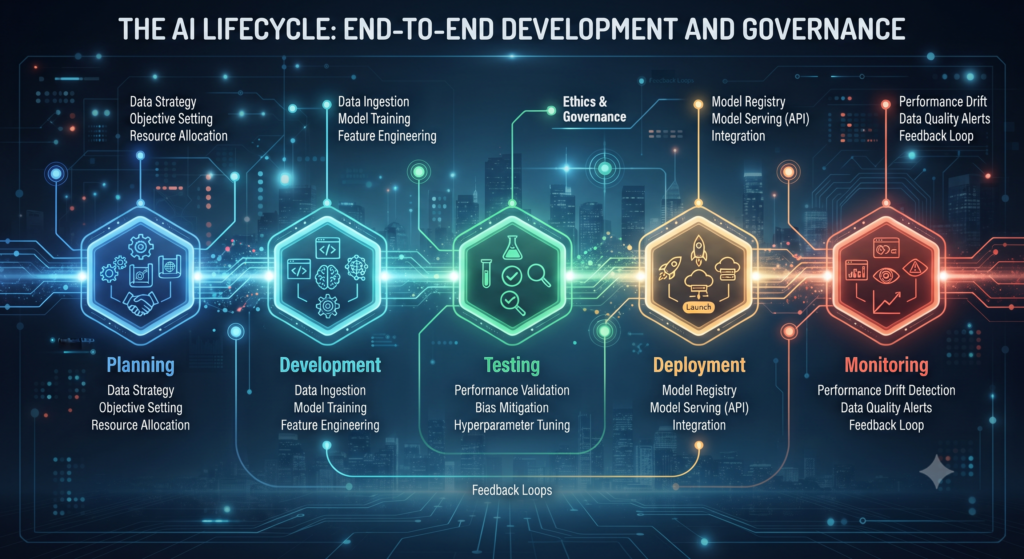
Enterprise AI Lifecycle Governance Table
| Lifecycle Stage | Governance Focus |
| Planning | Business alignment, objectives, and AI business context refinement |
| Development | Data quality management, AI model training, and governance |
| Testing | Model validation, risk assessment, and compliance checks |
| Deployment | Compliance verification, monitoring, and business integration |
| Monitoring | Performance tracking, continuous refinement, and optimization |
| Retirement | Secure decommissioning and governance documentation |
Organizations that govern every stage of the AI lifecycle consistently achieve stronger AI performance, improved business intelligence, lower operational risks, and better long-term business outcomes.
Organizational Learning, Context Engineering, and Scalable AI Adoption
As organizations expand their use of artificial intelligence, continuous learning becomes essential for long-term success. Every AI implementation generates valuable insights that help businesses improve future projects. AI governance combined with AI business context refinement enables organizations to capture these lessons, strengthen organizational knowledge, and accelerate enterprise-wide AI adoption.
One of the fastest-growing concepts in enterprise AI is context engineering. Unlike traditional AI development, context engineering focuses on providing AI systems with organizational knowledge, business rules, operational workflows, customer expectations, and strategic priorities. Through AI business context refinement, organizations enable AI to understand not only data but also the environment in which decisions are made.
This deeper contextual understanding significantly improves AI decision-making, business intelligence, predictive analytics, and customer experience. AI systems become more adaptable because they continuously learn from changing business environments while remaining aligned with governance policies.
Scalable AI adoption requires governance structures capable of growing alongside business expansion. As organizations deploy AI across multiple departments, governance frameworks must maintain consistency while remaining flexible enough to support innovation. AI business context refinement ensures every department benefits from context-aware AI without sacrificing quality, accountability, or compliance.
Industry-leading organizations increasingly view governance as a business enabler rather than a limitation. Structured oversight creates a secure environment where innovation can flourish responsibly. This balance between creativity and governance supports digital transformation, responsible AI innovation, and sustainable competitive advantage.
Real-World Example
A healthcare organization implemented comprehensive AI governance before introducing AI-powered diagnostic systems. Through continuous AI business context refinement, clinicians integrated medical guidelines, patient history, regulatory requirements, and clinical workflows into the AI platform. As a result, diagnostic consistency improved significantly, decision errors declined, and healthcare professionals developed greater trust in AI-assisted recommendations. The organization successfully expanded AI adoption while maintaining patient safety and regulatory compliance.
Future-Proofing Business Growth Through Responsible AI Governance
Artificial intelligence will continue transforming industries through machine learning, predictive analytics, autonomous AI, and intelligent automation. As these technologies become increasingly sophisticated, AI governance and AI business context refinement will become even more important for ensuring responsible growth.
Future-ready governance frameworks are designed to evolve alongside technology. They adapt to emerging regulations, changing customer expectations, new business models, and rapidly advancing AI capabilities. Organizations that continuously invest in AI business context refinement remain agile while preserving AI transparency, AI accountability, business alignment, and operational resilience.
Technology leaders no longer view governance solely as a compliance requirement. Instead, they recognize it as a strategic capability that improves AI accuracy, strengthens enterprise AI governance, supports business transformation, and increases long-term organizational resilience. Companies that combine innovation with effective governance consistently outperform organizations that rely only on technical performance.
The relationship between governance and AI innovation resembles the foundation of a skyscraper. As buildings grow taller, stronger foundations become increasingly important. Likewise, as AI systems become more powerful, organizations require stronger governance and continuous AI business context refinement to provide stability, trust, direction, and sustainable business success.
Enterprise AI Governance Implementation Roadmap
| Phase | Objective | Key Activities |
| Assessment | Understand organizational readiness | Evaluate business needs and existing AI maturity |
| Strategy | Define governance vision | Develop governance policies and AI business context refinement strategy |
| Development | Build governance framework | Establish controls, accountability, and oversight |
| Deployment | Launch governance program | Implement monitoring, validation, and reporting systems |
| Optimization | Improve AI performance | Refine AI models through continuous improvement |
| Expansion | Scale enterprise AI | Extend governance across the organization |
Frequently Asked Questions
What is AI Governance in Business Context?
AI Governance in Business Context refers to the policies, governance controls, accountability measures, and oversight processes that ensure AI systems align with organizational objectives. AI business context refinement further strengthens governance by enabling AI models to understand real-world business conditions and strategic priorities.
How does AI governance improve business accuracy?
AI governance improves AI accuracy by strengthening data quality, validating AI outputs, monitoring performance, supporting AI business context refinement, and ensuring recommendations reflect actual business environments rather than isolated datasets.
Why is business alignment important in AI governance?
Business alignment ensures AI initiatives contribute directly to organizational strategy, customer satisfaction, operational efficiency, and measurable business outcomes. Continuous AI business context refinement helps maintain this alignment as business priorities evolve.
What are the main components of an AI governance framework?
An effective AI governance framework includes data governance, risk management, AI accountability, compliance management, AI monitoring, model validation, AI lifecycle management, ethical AI, and AI business context refinement.
How does governance support regulatory compliance?
Governance establishes policies, documentation, monitoring procedures, and accountability structures that help organizations comply with industry regulations while reducing legal, financial, and operational risks through continuous AI business context refinement.
What role does AI refinement play in governance?
AI refinement continuously improves model performance through feedback loops, context validation, performance monitoring, and AI business context refinement, ensuring AI systems remain accurate, reliable, and aligned with changing business needs.
Can small businesses benefit from AI governance?
Absolutely. Small businesses can use AI governance and AI business context refinement to improve decision-making, reduce risks, strengthen transparency, increase customer trust, and ensure AI investments support long-term business growth.
Conclusion
Artificial intelligence is reshaping modern business, but long-term success depends on more than powerful algorithms. Effective AI governance combined with AI business context refinement provides the structure organizations need to improve AI accuracy, strengthen business alignment, support continuous improvement, and maintain responsible innovation. Governance ensures that AI systems remain transparent, accountable, secure, and focused on delivering measurable business value.
Organizations that invest in comprehensive AI governance frameworks gain much more than regulatory compliance. They improve decision intelligence, strengthen business resilience, enhance operational efficiency, increase customer trust, and accelerate digital transformation. By embedding AI business context refinement throughout the AI lifecycle, businesses create intelligent systems that continuously adapt to changing market conditions while remaining aligned with organizational goals.
As AI continues to evolve, governance will remain the foundation that transforms advanced technology into trusted business capability. Companies that prioritize AI business context refinement, responsible AI, and enterprise AI governance today will be better positioned to innovate responsibly, compete effectively, and achieve sustainable long-term growth.
good job