What Is Natural Language Processing (NLP) AI?
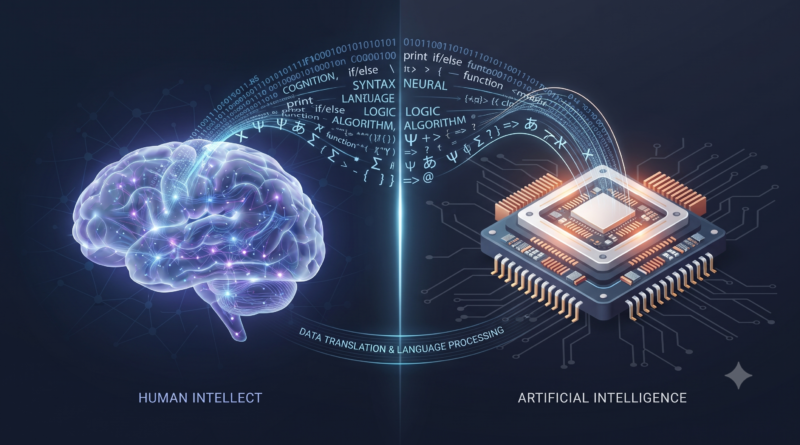
What Is Natural Language Processing (NLP) AI? It is the technology that allows computers to understand, interpret, and generate human language. Have you ever wondered how your phone understands voice commands or how a chatbot answers questions within seconds? The answer lies in Natural Language Processing (NLP), one of the most important branches of Artificial Intelligence. NLP enables machines to communicate with people in a more natural and meaningful way by processing both written and spoken language.
Today, NLP in AI powers everything from virtual assistants and translation apps to customer support systems and search engines. Businesses use it to analyze customer feedback, automate repetitive tasks, and uncover valuable insights hidden within large volumes of text. As Large Language Models (LLMs) continue to evolve, the capabilities and Natural Language Processing benefits keep expanding across industries. Understanding What Is Natural Language Processing (NLP) AI? and how it works helps explain the technology driving modern communication, smarter automation, and data-driven decision-making.
What Is Natural Language Processing (NLP)?
What Is Natural Language Processing (NLP) AI? It is a branch of Artificial Intelligence that enables computers to understand, interpret, and generate human language. At its core, Natural Language Processing combines Computational Linguistics, Machine Learning Algorithms, and Artificial Intelligence to bridge the gap between human communication and computer understanding. While people naturally communicate through words, emotions, and context, computers rely on numbers and patterns to process information.
When people ask What Is Natural Language Processing (NLP) AI?, the simplest explanation is that it allows computers to read, listen, understand, and respond to human language. Whether you use email spam filters, translation tools, search engines, or voice assistants, you interact with NLP technology every day. Through Human Language Processing, machines recognize meaning, identify language patterns, and generate useful responses based on text or speech.
Why Natural Language Processing Matters Today
The importance of What Is Natural Language Processing (NLP) AI? continues to grow because modern organizations generate enormous amounts of text every day. Emails, customer reviews, social media posts, support tickets, and business reports contain valuable insights. Without automation, analyzing this information would require significant time and resources. Technologies such as Text Analytics, Text Mining, and Information Extraction enable businesses to process large volumes of language quickly and accurately.
At the same time, users expect technology to understand natural conversations. This growing demand has increased the importance of Human-Computer Interaction and Conversational AI. From online shopping assistants to healthcare applications, NLP helps create more intuitive digital experiences. Understanding What Is Natural Language Processing (NLP) AI? also highlights how organizations transform unstructured language into actionable insights that improve products, services, and customer satisfaction.
How Natural Language Processing Works
To understand What Is Natural Language Processing (NLP) AI?, imagine teaching a computer to understand language in much the same way a child learns to communicate. The process begins by collecting text or speech data. The information then goes through Data Preprocessing, where unnecessary characters, spelling errors, and irrelevant content are removed. This step improves data quality and prepares it for accurate analysis.
After preprocessing, the system performs Tokenization, Text Normalization, Feature Extraction, and Context Analysis. Advanced Neural Networks and Deep Learning Models analyze relationships between words, phrases, and sentence structures to understand meaning more effectively. Finally, the AI model generates an output such as a translation, recommendation, summary, or answer. This complete workflow demonstrates What Is Natural Language Processing (NLP) AI? in action, allowing machines to move beyond simple keyword matching toward advanced Language Understanding and Language Generation.
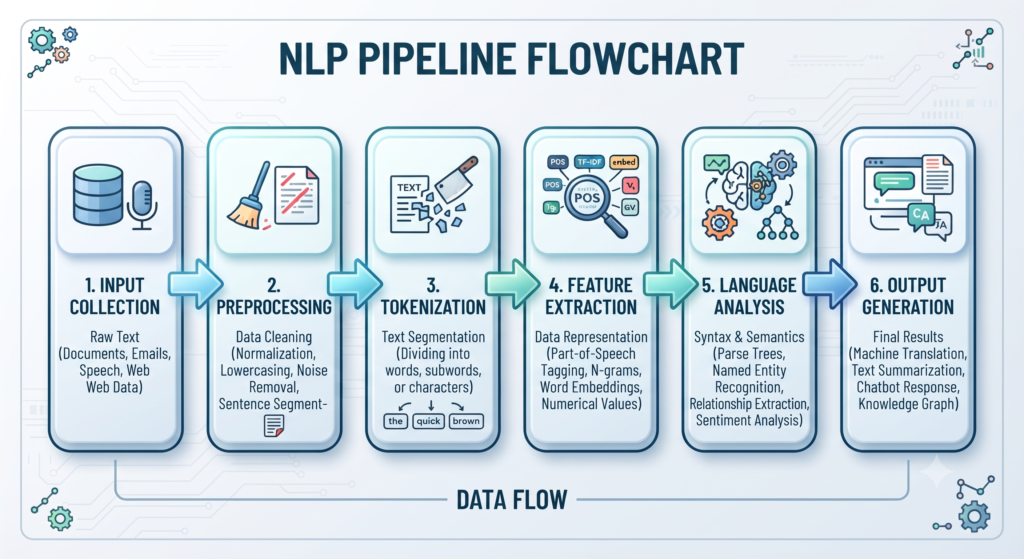
NLP Processing Flow
| Stage | Purpose |
| Input Collection | Gather text or speech |
| Data Preprocessing | Clean and organize data |
| Tokenization | Split text into meaningful units |
| Feature Extraction | Convert text into machine-readable data |
| Language Analysis | Understand context and meaning |
| Model Training | Learn patterns from language data |
| Output Generation | Produce translations, summaries, answers, or predictions |
Core Components and Techniques Used in NLP
Several techniques work together to make NLP successful. Natural Language Understanding (NLU) focuses on interpreting meaning, identifying intent, and understanding context. Natural Language Generation (NLG) allows systems to create human-like responses, summaries, and conversations. These two areas form the backbone of many modern AI applications.
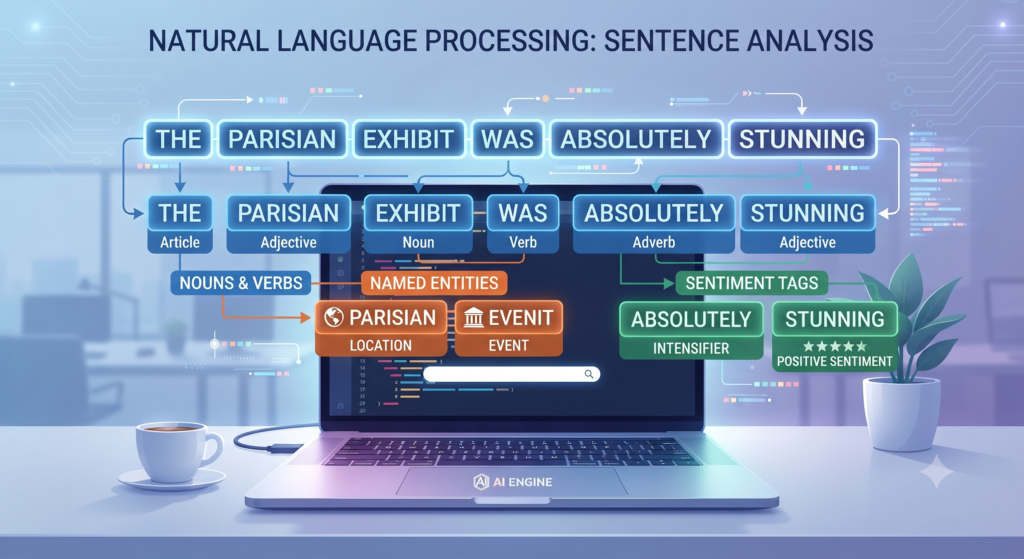
Additional techniques include Part-of-Speech Tagging, Named Entity Recognition (NER), Syntax Analysis, Dependency Parsing, and Semantic Analysis. Together, they help machines understand sentence structure, relationships between words, and overall meaning. Modern Language Models use these methods to provide accurate and context-aware responses that feel natural to users.
Common Natural Language Processing Tasks
One reason NLP Applications are so widespread is their versatility. Different NLP tasks solve different business and consumer challenges. A customer service chatbot uses language understanding, while a translation platform focuses on converting one language into another
Common NLP Tasks
Named Entity Recognition (NER): Extracts important entities such as names of people, organizations, locations, dates, and currencies from text.
Machine Translation: Transforms written content from one language into another while preserving its meaning and context.
Sentiment Analysis: Evaluates text to determine the underlying emotion, opinion, or attitude, such as positive, negative, or neutral sentiment.
Text Summarization: Condenses lengthy documents into shorter summaries that highlight the most important information.
Text Classification: Organizes text into predefined categories, such as spam detection, topic identification, or intent recognition.
Question Answering Systems: Enables machines to understand questions and provide accurate answers by analyzing relevant text or knowledge sources.
Top Benefits of Natural Language Processing
One of the biggest benefits of NLP is speed. Computers can analyze millions of words in seconds. Tasks that once required entire teams can now be completed automatically. This efficiency helps businesses reduce costs while improving productivity and decision-making.
Another major advantage is accuracy. Advanced NLP systems identify trends, emotions, and patterns that humans may overlook. Through Predictive Analytics, Semantic Meaning analysis, and automated reporting, organizations gain valuable insights. These Natural Language Processing Benefits help businesses improve customer service, marketing strategies, and operational performance.

Key Benefits of NLP
| Benefit | Business Impact |
| Automation | Saves time and labor |
| Faster Analysis | Processes large datasets |
| Better Decisions | Improves insights |
| Customer Support | Enhances service quality |
| Personalization | Creates better experiences |
| Scalability | Handles growing data volumes |
Improving Customer Experience with NLP
Customers want fast answers and personalized interactions. NLP helps businesses meet these expectations through AI-Powered Tools that understand customer requests and provide relevant responses. Instead of waiting for human agents, users can receive instant support at any time of day.
Another powerful use case involves customer feedback analysis. Companies use Text Processing, Context Understanding, and Sentiment Analysis to evaluate reviews, surveys, and social media comments. This approach helps organizations identify pain points, improve products, and strengthen customer relationships. A business that listens effectively often gains a competitive advantage.

NLP in Business Intelligence and Data Analysis
Business leaders depend on information to make decisions. However, much of that information exists in unstructured formats. Emails, reports, and customer comments contain valuable insights that are difficult to analyze manually. NLP transforms this information into meaningful data.
Through Business Intelligence, Text Analytics, and Information Extraction, organizations uncover patterns hidden inside large datasets. A retail company may discover changing customer preferences while a financial institution may identify emerging market trends. These insights help businesses respond faster and make smarter decisions based on evidence rather than assumptions.
Real-World Applications of NLP Across Industries
The influence of NLP extends far beyond technology companies. In healthcare, NLP helps doctors analyze patient records and identify relevant medical information. Hospitals use Language Technologies to improve documentation and reduce administrative workloads. These improvements save time and support better patient care.
Financial institutions use NLP for fraud detection, market analysis, and risk management. Retailers apply it to recommendation systems and customer support. Educational platforms leverage Human Language Understanding to personalize learning experiences. Across industries, NLP Examples demonstrate how language data can create practical business value.
Industry Applications of NLP
| Industry | Example Application |
| Healthcare | Medical record analysis |
| Finance | Fraud detection |
| Retail | Product recommendations |
| Education | Personalized learning |
| Marketing | Customer sentiment tracking |
| Legal | Contract analysis |
How NLP Powers Chatbots and Virtual Assistants
When you interact with a chatbot, multiple NLP processes occur behind the scenes. The system analyzes your words, determines your intent, evaluates context, and generates an appropriate response. This combination of Language Interpretation, Context Awareness, and Natural Language Generation creates conversations that feel natural.
Popular tools such as ChatGPT, Siri, and Alexa rely heavily on NLP technologies. These systems continuously improve through training data and advanced Transformer Models. As a result, modern virtual assistants can answer questions, schedule appointments, provide recommendations, and perform complex tasks with increasing accuracy.
Everyday Examples of NLP You Already Use
Many people use Natural Language Processing every day without realizing it. When you type a message and your smartphone suggests the next word, NLP is working in the background. When a search engine understands what you mean instead of matching exact words, advanced Language Models and Context Analysis help deliver accurate results.
Voice assistants such as Siri and Alexa are also common NLP Examples. These systems combine Speech Recognition, Language Understanding, and Conversational AI to interpret commands and provide answers. Translation tools, spam filters, and recommendation engines also depend on Human Language Processing to improve user experiences and make technology feel more natural.
Everyday NLP Examples
| Technology | NLP Function |
| Search Engines | Query understanding |
| Voice Assistants | Speech-to-text processing |
| Email Filters | Spam detection |
| Translation Apps | Automated translation |
| Chatbots | Customer interaction |
| Smart Keyboards | Predictive text |
Challenges and Limitations of Natural Language Processing
Sarcasm, humor, slang, and regional dialects create additional challenges. Many Machine Learning Algorithms perform well with common language patterns yet struggle with unusual expressions. Data quality is another concern because inaccurate or biased training data can affect outcomes. As organizations increasingly rely on NLP, addressing fairness, privacy, and ethical considerations ties directly into broader AI governance for strategic visibility that responsible businesses must adopt.
Challenges Businesses Face When Implementing NLP
Businesses often discover that implementing NLP requires more than purchasing software. Successful projects depend on high-quality data, skilled professionals, and ongoing optimization. Many organizations store information across multiple systems, making integration a complicated process.
Another challenge involves scalability and cost. Training advanced Deep Learning Models and Neural Networks requires substantial computing power. Companies must also evaluate return on investment and ensure compliance with privacy regulations. While the rewards can be significant, successful implementation demands careful planning and long-term commitment.
Common Business NLP Challenges
| Challenge | Impact |
| Poor Data Quality | Reduced accuracy |
| High Costs | Increased investment |
| System Integration | Deployment complexity |
| Data Privacy | Compliance concerns |
| Scalability | Infrastructure demands |
| Skill Gaps | Talent shortages |
Popular NLP Tools and Frameworks for Developers
Developers have access to many powerful NLP frameworks. Some tools focus on research while others support enterprise-level deployment. The right choice depends on project goals, technical requirements, and available resources.
Several platforms have become industry standards because of their flexibility and strong community support. These tools help developers build applications involving Text Processing, Sentiment Analysis, Named Entity Recognition (NER), and Language Generation.
Popular NLP Tools
| Tool | Primary Purpose |
| NLTK | Education and research |
| Stanford CoreNLP | Linguistic analysis |
| TensorFlow | Deep learning development |
| spaCy | Production NLP applications |
| PyTorch | AI model training |
| Hugging Face | Transformer models |
Mini Case Study: Customer Support Automation
A large online retailer received thousands of support requests every day. Human agents struggled to respond quickly during peak shopping seasons. The company implemented an NLP-powered chatbot that used Natural Language Understanding (NLU) and Context Awareness to answer common questions.
Within months, response times decreased significantly while customer satisfaction improved. Human agents focused on complex cases instead of repetitive requests. This example demonstrates how NLP Applications can increase efficiency while enhancing the customer experience.
Best NLP Tools and Technologies in 2026
The NLP landscape continues to evolve rapidly. Modern systems increasingly rely on Transformer Models, Large Language Models (LLMs), and advanced Generative AI technologies. These innovations allow machines to understand context more effectively and generate responses that closely resemble human communication.
Cloud-based NLP services have also become popular because they reduce infrastructure costs and simplify deployment. Businesses can access powerful AI-Powered Tools without building large internal AI teams. As technology advances, enterprise solutions continue becoming more accessible to organizations of every size.
Quote
“Language is humanity’s most powerful tool. NLP allows machines to participate in that conversation.”
The Future of Natural Language Processing and Artificial Intelligence
The future of Natural Language Processing looks incredibly promising. Researchers continue improving Human Language Understanding, making AI systems more accurate, context-aware, and adaptable. Future models will likely understand emotions, intent, and complex reasoning with greater precision than today’s systems.
Another major trend involves multimodal AI systems that combine text, speech, images, and video. These systems will create richer forms of Human-Computer Interaction and support more advanced applications. From healthcare diagnostics to personalized education, the next generation of NLP solutions could transform nearly every industry.
Future Trends in NLP
| Trend | Expected Impact |
| Multimodal AI | Better understanding |
| Advanced LLMs | Improved reasoning |
| Real-Time Translation | Global communication |
| Industry-Specific Models | Higher accuracy |
| Ethical AI | Increased trust |
| Autonomous Assistants | Greater productivity |
Frequently Asked Questions (FAQs)
What is Natural Language Processing in simple words?
Natural Language Processing is a branch of Artificial Intelligence that helps computers understand, interpret, and generate human language. It allows machines to communicate more naturally with people.
How does NLP work?
NLP works by collecting language data, performing Data Preprocessing, applying Feature Extraction, and training Machine Learning models to recognize patterns and generate meaningful outputs.
What are the benefits of NLP?
The main benefits of NLP include automation, faster analysis, improved decision-making, better customer experiences, reduced costs, and enhanced operational efficiency.
What are common NLP applications?
Popular NLP Applications include chatbots, virtual assistants, machine translation, sentiment analysis, document search, recommendation systems, and speech recognition.
Is NLP part of Artificial Intelligence?
Yes. NLP in AI is a specialized field that focuses on helping computers understand and process human language.
What is the difference between NLP and Machine Learning?
Machine Learning teaches computers to learn patterns from data. NLP specifically focuses on understanding and generating language. Modern NLP often uses machine learning techniques.
Which industries use NLP the most?
Healthcare, finance, retail, education, marketing, legal services, and customer support are among the industries that rely heavily on NLP technologies.
What are the best NLP tools for beginners?
Many beginners start with NLTK, spaCy, and TensorFlow because they offer extensive documentation, learning resources, and active user communities.
Conclusion
As digital communication continues growing, Natural Language Processing has become one of the most valuable technologies in modern computing. From Speech Recognition and Machine Translation to Conversational AI and Text Analytics, NLP helps organizations transform language into actionable insights. Businesses use it to automate processes, improve customer experiences, and make smarter decisions based on data.
Understanding What is NLP is no longer limited to data scientists and engineers. Whether you are a business owner, student, marketer, or technology enthusiast, NLP affects the tools you use every day. As Artificial Intelligence, Deep Learning Models, and Large Language Models continue evolving, the future of NLP will create even more opportunities for innovation, efficiency, and meaningful human-computer communication.