
9 Ways AI Improves Decision-Making for Growing Businesses
Decision-Making for Growing Businesses changes fast once a company scales past its early stage. Leaders can no longer rely on gut feeling alone. Decision-Making for Growing Businesses now depends on data, speed, and smart tools working together. This article covers nine clear ways artificial intelligence for business growth reshapes how leaders think, plan, and act every single day.
You will learn how machine learning, predictive analytics, and generative AI support AI decision-making across departments large and small. Each section keeps things simple and grounded in real examples. No jargon. No filler. Just practical insight you can put to use this week to sharpen your own business intelligence process and reduce costly guesswork.
Growth exposes weak spots. A pricing mistake that once cost a few hundred dollars can suddenly cost tens of thousands once volume rises. That is the real reason so many founders start searching for smarter systems the moment their headcount crosses a certain threshold. This piece walks through exactly where AI fits into that search.
Why Decision-Making Gets Harder as Businesses Grow
Small teams move fast. Everyone talks daily, so choices happen naturally around a shared table or a quick group chat. But growth changes that rhythm completely, often within a matter of months rather than years. More people join, more data piles up, and suddenly one person cannot hold the full picture in their head anymore. This is where digital transformation becomes less of a buzzword and more of a genuine survival tool for the business.
Research from McKinsey has repeatedly shown that companies with strong AI adoption in business practices outperform slower peers on both speed and profit margin. Growing companies face real friction here, and it rarely announces itself loudly. Departments start working in silos, spreadsheets multiply across shared drives, and small errors quietly snowball into larger ones. Better decision support systems fix this gap before it becomes an expensive habit baked into daily operations.Getting this foundation right often starts with AI governance for business, since clear rules around how AI is used tend to prevent the silo problem from forming in the first place
There is also a psychological cost that leaders rarely discuss openly. Decision fatigue sets in when founders spend their entire day approving small requests instead of thinking about strategy. A leader who reviews forty minor purchase orders before lunch has little energy left for the choices that truly move the company forward. AI absorbs much of that low-value decision load, quietly, in the background, freeing up mental bandwidth for bigger questions.
Consider a mid-sized logistics company that grew from twenty to two hundred employees within eighteen months. Its founder later described the period as trying to steer a ship while also rebuilding the engine. That kind of strain is common, and it explains why so many growing businesses now treat AI decision-making tools as core infrastructure rather than an optional upgrade.
1. How AI Transforms Complex Data Into Meaningful Insights
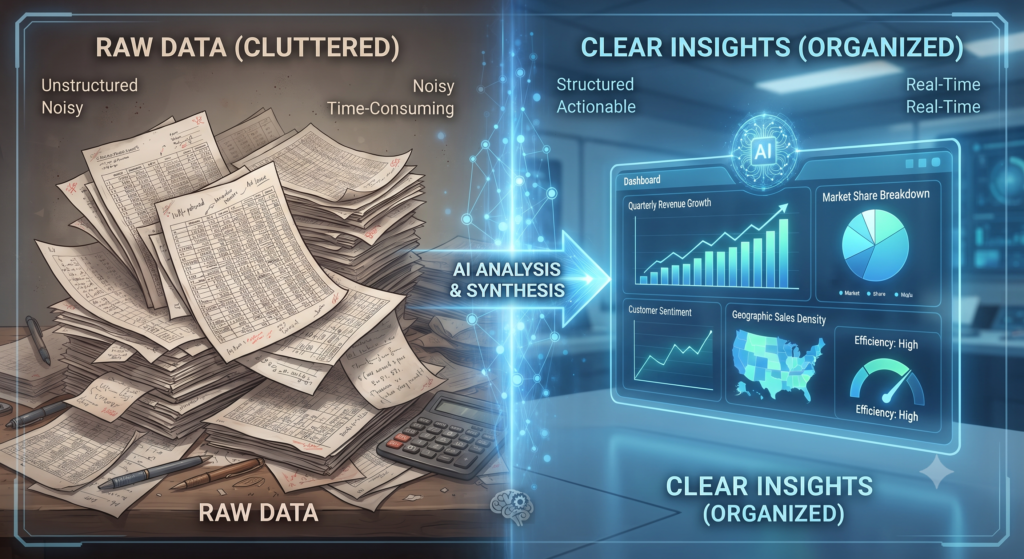
Numbers alone do not run a business. Someone has to make sense of them, and that task grows harder as data sources multiply across departments. That is exactly where AI data analytics proves its worth for a growing team. Modern platforms like Tableau pull scattered numbers into clean, visual dashboards that update automatically. Instead of scrolling through endless spreadsheet rows, you see trends the moment they appear on screen.
This kind of pattern recognition used to take skilled analysts several days to complete by hand. Now it takes seconds, and the output is often more reliable because the system checks thousands of variables at once. Think of AI as an experienced translator. It takes a language you do not naturally speak, raw numerical data, and turns it into plain English you can act on immediately without a technical background.
Teams no longer need a data science degree to understand company performance at a glance. Natural language processing even lets a manager type a plain question, such as which product line underperformed last month, and receive a written answer within moments. That shift alone saves hours every single week across an average mid-sized company, hours that used to disappear into manual report building.
A useful analogy here involves cooking. A chef with fresh, well-organized ingredients cooks faster and better than one digging through a cluttered pantry. AI data analytics organizes the pantry for you, so decision-makers spend their time cooking, meaning making real choices, rather than searching for the right ingredient buried at the back of a shelf.
2. AI Speeds Up Decisions Without Sacrificing Accuracy
Speed and accuracy usually fight each other in traditional business settings. Rush a decision and mistakes creep in unnoticed. Slow down too much and genuine opportunities quietly vanish while competitors move first. AI breaks that old trade-off in a way that feels almost unfair to companies still relying on manual review. Tools built into platforms like Salesforce and HubSpot deliver real-time business insights the moment underlying data updates anywhere in the system.
You are no longer waiting for next month’s report to know what happened last week or even yesterday afternoon. Picture a retail manager checking stock levels across a dozen store locations. In the past, this required several phone calls and an educated guess based on last quarter’s numbers. Today, AI-enabled decision-making shows live inventory across every store at once, updated automatically as sales happen at the register.
Faster business decisions become routine instead of rare, almost boring in the best possible sense. Accuracy actually improves too, because the system checks patterns a tired human team would likely miss during a hectic Monday morning. A well-known case involves a national coffee chain that used real-time demand data to adjust staffing schedules within hours rather than waiting for a weekly review meeting.
Speed without accuracy is reckless. Accuracy without speed is often too late to matter. Growing businesses need both qualities working together, and this is precisely the gap that modern AI systems were built to close. The result is a decision cycle that feels less like guessing and more like informed, confident action taken in real time.

3. How AI Helps Minimize Bias and Improve Decision Accuracy
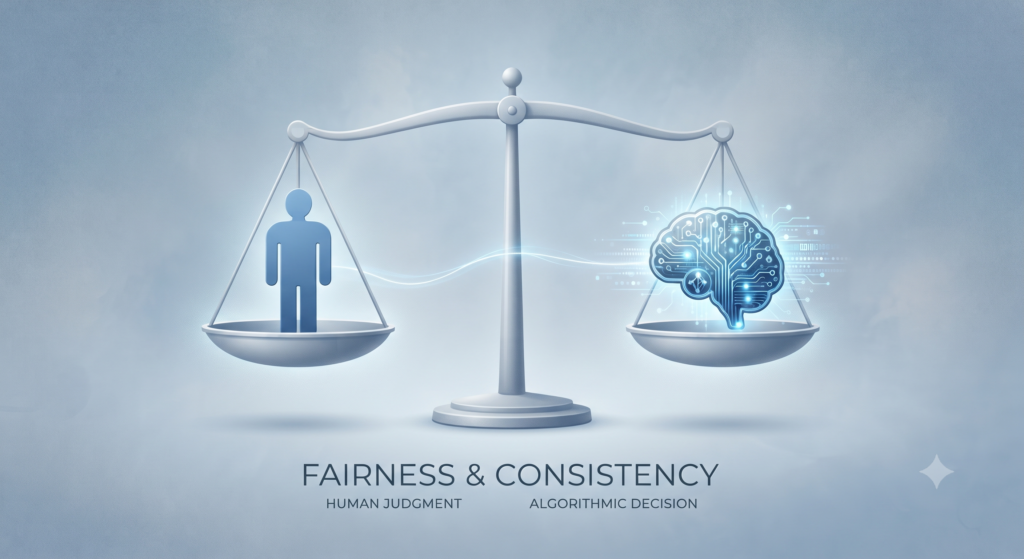
Everyone carries bias, even the most skilled and experienced leaders in any industry. A bad night of sleep, a personal preference, or simple fatigue can quietly steer a big call in the wrong direction. AI does not get tired or moody, and it applies the same underlying logic every single time a decision comes up for review. This leads to genuine human error reduction across hiring, pricing, and long-term planning decisions.
Consider a hiring example. A manager reviewing one hundred resumes late on a Friday afternoon is statistically more likely to reject qualified candidates simply out of exhaustion. AI screening tools do not experience that decline in attention. They apply consistent criteria to candidate number one and candidate number one hundred, which levels the playing field considerably for everyone involved in the process.
That said, AI is not magic, and it would be dishonest to pretend otherwise. If the training data carries hidden bias, the output will likely carry that same bias forward into new decisions. Smart leaders treat AI as a partnership rather than a full replacement for human judgment. Data-backed strategies work best when a person still reviews the final call before it becomes permanent policy.
The goal here is balance, not blind trust in a machine that only knows what it was originally taught to recognize. Companies that audit their AI systems regularly catch these issues early, long before they turn into a public relations problem or a legal headache. Bias reduction is a process, not a one-time fix applied at launch and forgotten.
4. AI Automates Routine Decisions So Leaders Can Focus on Strategy
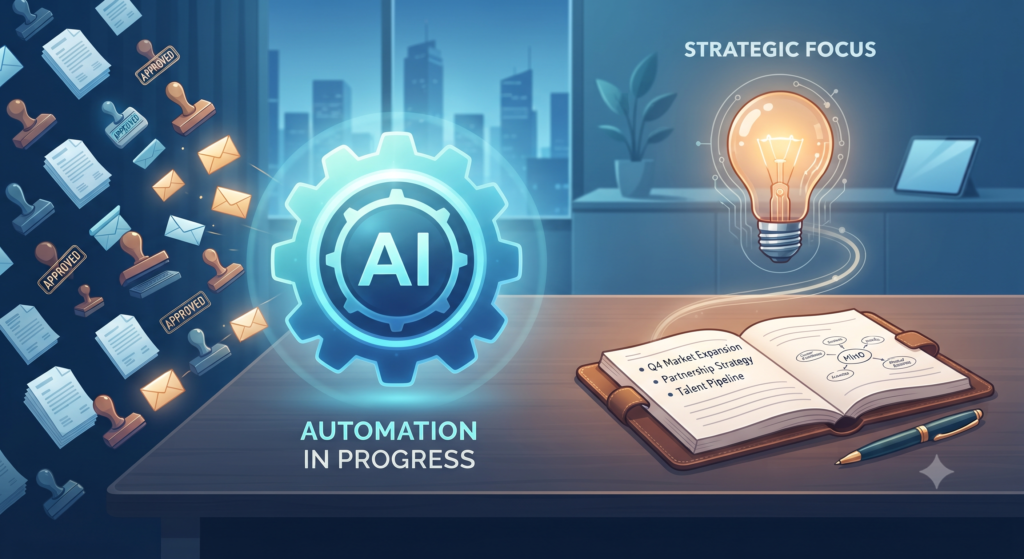
Not every decision deserves a meeting, and yet many growing companies treat every choice with the same level of ceremony. Reordering office supplies, approving small expenses, or scheduling routine follow-up emails do not need a human involved every single time this happens. Business process automation handles these small, repeatable tasks quietly in the background without ever needing a status update.Order and fulfillment workflows are a good example of this in practice — see how it plays out in AI order management.
This is where workflow automation truly shines for busy leadership teams stretched thin across too many responsibilities at once. Freeing up this mental space matters more than most people realize until they actually experience the change themselves. When routine choices run on autopilot, leaders get their attention back for the decisions that genuinely shape the company’s future direction and competitive position.
AI-powered reporting also means fewer status meetings overall, since the numbers update themselves automatically and reach the right inbox without anyone needing to compile a slide deck first. One marketing agency reported cutting its weekly meeting load nearly in half after automating its client reporting process, freeing up almost a full workday per employee, per week.
There is a simple test worth applying here. If a decision follows the exact same rule every time, it probably belongs to automation rather than a human calendar slot. Save the meetings for decisions that genuinely require debate, creativity, or judgment calls that no algorithm has been trained to make. That distinction alone can transform how a growing team spends its most limited resource, which is attention itself.
5. AI Enables Predictive, Forward-Looking Planning
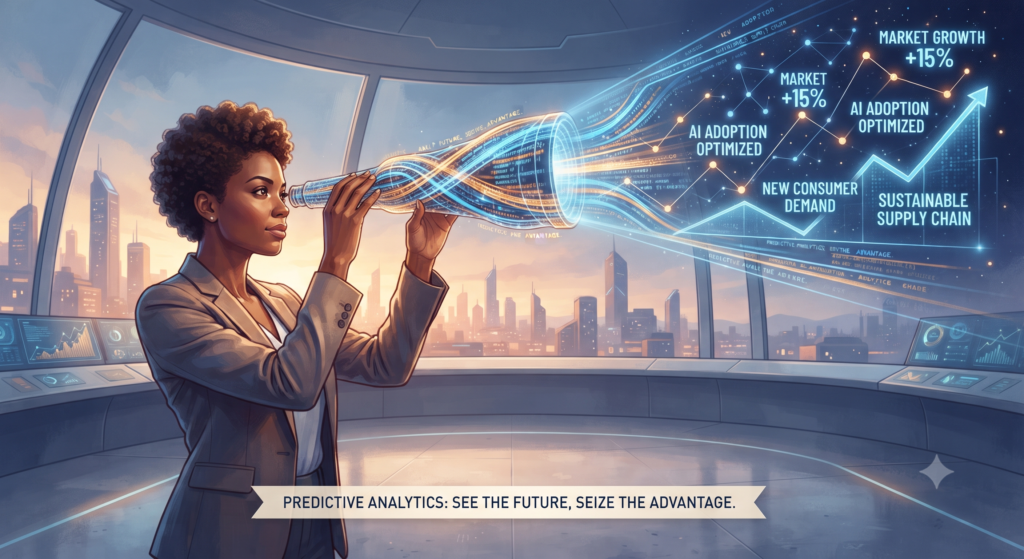
Waiting for a quarterly report to reveal a problem is a bit like checking the weather forecast after you already got soaked walking home. Predictive analytics in business flips that timeline entirely, giving leaders a genuine head start. Models trained on historical data forecasting can flag a slowing sales trend weeks before it ever shows up clearly on a spreadsheet, giving leaders real room to react early rather than scrambling later.
This matters most in supply chain optimization, an area where small delays can cascade into major losses within days. A company using machine learning forecasting can predict a spike in demand and adjust inventory before store shelves ever go empty during a busy season. Inventory demand prediction also reduces waste considerably, since businesses stop over-ordering products that customers simply do not want that particular month.
Planning stops being a guessing game and starts becoming something closer to an applied science. A regional grocery chain, for example, used forecasting models to reduce spoiled produce by cutting unnecessary orders tied to outdated seasonal assumptions. The savings were substantial, and the change required no new hires, only a shift in how ordering decisions got made each week.
Forecasting is never perfect, and any honest discussion of predictive tools should acknowledge that upfront. Markets shift, and unexpected events still catch even the best models off guard occasionally. Still, an imperfect forecast beats no forecast at all, and the margin of error keeps shrinking as these systems process more historical cycles over time.
6. AI Improves Decision Quality Over Time Through Continuous Learning
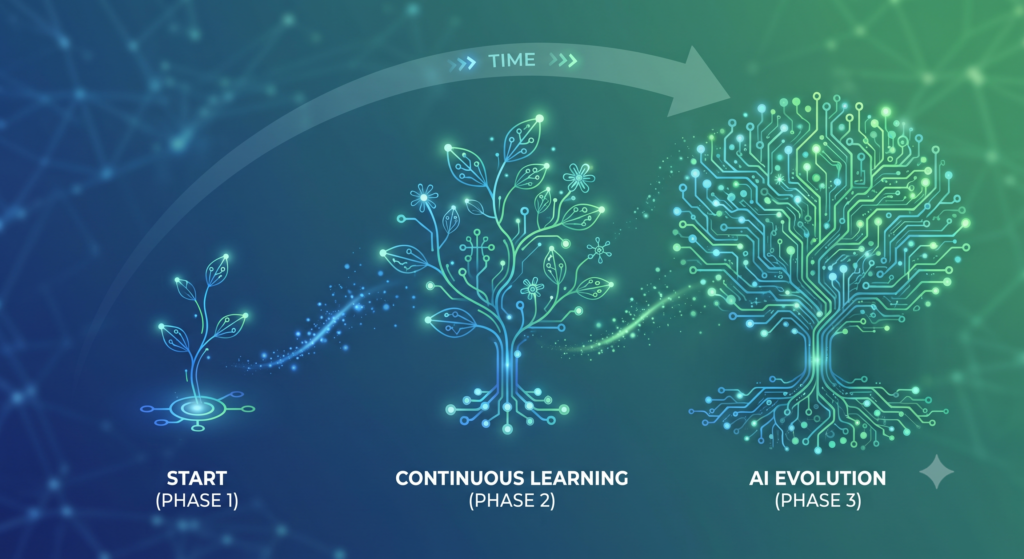
Static software stays exactly the same forever, which is precisely its biggest limitation for a growing business. AI does not share that limitation. Every interaction, click, and outcome feeds back into the system, quietly making it sharper with each passing week. Platforms use this feedback loop to refine recommendations the longer a business actually uses them in daily operations. It behaves a bit like a new employee who never forgets a single lesson taught during onboarding. This steady improvement builds real business performance tracking over time, layer by layer, rather than arriving all at once. A tool that felt just average during month one often becomes genuinely impressive by month six, once it has learned the specific patterns unique to that particular business.
That compounding effect is one major reason AI adoption in business keeps accelerating across so many different industries, from retail and logistics to finance and healthcare administration. Early adopters often gain a quiet head start that becomes harder for competitors to close later, simply because the system has had more time to learn the business’s specific rhythms and quirks.
Continuous learning does require oversight, however. A system trained on outdated assumptions can drift in the wrong direction if nobody checks in periodically. Treat these tools like a garden rather than a vending machine. Regular attention keeps growth healthy, while total neglect eventually produces disappointing results no matter how sophisticated the underlying technology happens to be.
7. AI Strengthens Risk Management and Early Warning Signals
Growth brings exposure, whether leaders want to admit it or not. More customers, more transactions, and more chances for something to quietly go wrong somewhere in the background of daily operations. AI risk management tools scan constantly for unusual patterns, the kind a busy human team might miss entirely during a normal, hectic workday. This is especially visible in insurance AI use cases, where claims analysis now runs through automated fraud detection before a human employee ever opens the actual file.
Predictive risk analysis also studies past incidents closely to flag similar risks before they have a chance to repeat themselves in a new form. Catching a warning sign during week one is far cheaper, and far less stressful, than explaining a full-blown crisis to investors during week twelve. Historical data analysis turns old mistakes into a genuine early warning system, rather than a lesson nobody in the company actually remembers six months later.
A regional bank once caught an unusual pattern of small, repeated transactions across dozens of accounts using exactly this kind of anomaly detection. Human reviewers had missed the pattern for weeks because each individual transaction looked completely harmless on its own. The AI system flagged the connection almost immediately once enough data accumulated, saving the bank a significant loss and a considerable amount of reputational damage.
Risk management used to feel reactive, almost like putting out fires after they had already spread. Modern AI risk management tools shift that posture toward genuine prevention. Growing businesses that adopt this mindset early tend to weather industry downturns with noticeably less damage than competitors still relying entirely on manual audits and after-the-fact reviews.the same shift in mindset covered in AI governance for strategic visibility

8. AI Enhances Collaboration Between Teams and Technology
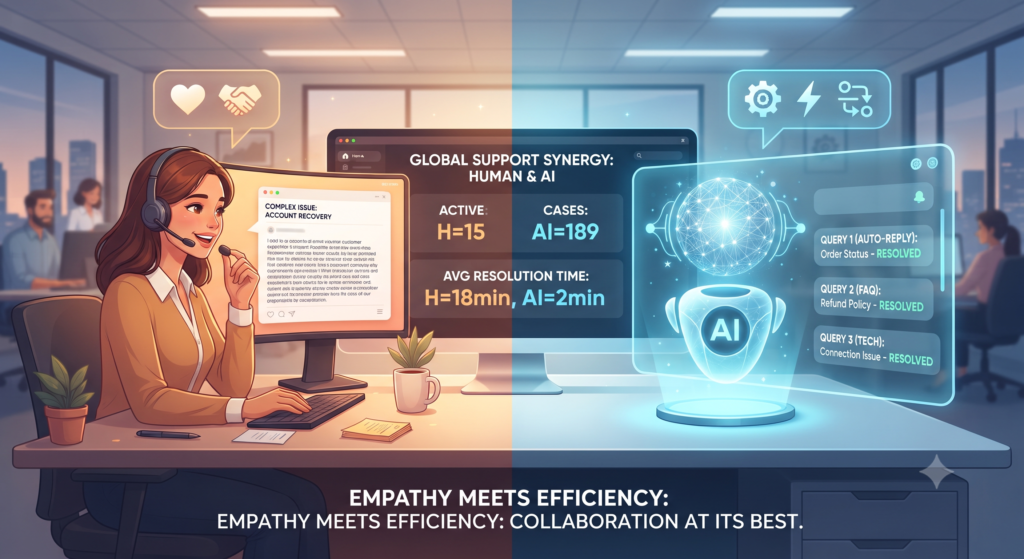
Great decisions blend machine precision with human judgment, and neither one works particularly well entirely alone. AI surfaces the data quickly and consistently, but people still bring context, empathy, and lived experience that no machine can fully replicate today. This shows up clearly in AI customer experience work, where AI chatbots now handle 24/7 customer support without ever wearing anyone on the team out.
Consider automated emails that greet a new customer within seconds of signing up for a service or product trial. That kind of personalized customer interactions used to require a full support team working around the clock in shifts. Now, customer behavior analysis helps route trickier, more emotional questions to a real human agent, while AI comfortably handles the simple, repetitive ones without complaint.
Everyone wins in this arrangement, including the customer waiting patiently for a helpful answer instead of sitting in a long phone queue. A software company that implemented tiered AI support reported a noticeable drop in average response time, alongside happier support staff who no longer burned out answering the same five questions dozens of times each day.
Collaboration between people and technology works best when each side plays to its actual strength. AI handles volume, consistency, and speed. Humans handle nuance, empathy, and the messy judgment calls that genuinely require a person on the other end. Growing businesses that respect this division tend to build customer trust faster than those trying to automate everything indiscriminately.
9. AI Helps Growing Businesses Scale Decisions Without Scaling Headcount
Hiring a brand-new analyst for every fresh market you enter is simply not realistic for most growing companies operating on a tight budget. Enterprise AI solutions let a small, lean team make calls that once required a much larger department stretched across several time zones. This directly supports operational efficiency, letting fewer people cover far more ground without anyone quietly burning out along the way.
The financial upside here is real and fairly easy to measure over a few business quarters. AI cost reduction and waste reduction go hand in hand once automated systems start catching errors before they turn into expensive mistakes further down the line. Business productivity rises not because people suddenly work harder, but because the tools surrounding them finally pull their own weight in the process.
A software startup once expanded into three new international markets using the same ten-person analytics team that previously handled only its home market. AI-driven localization and demand forecasting tools absorbed the extra workload that would otherwise have required at least six additional hires. That kind of leverage used to belong only to large enterprises with deep pockets, and now it is available to companies at a much earlier stage of growth.
Scaling decisions without scaling headcount does not mean cutting corners on quality. It means directing human attention toward judgment calls that truly need it, while letting software handle the repetitive heavy lifting behind the scenes. Growing businesses that master this balance often outpace competitors still hiring their way through every new challenge that appears.

Smarter Business Decisions
Choosing the right AI tool matters just as much as the decision to adopt one in the first place. Look for platforms that connect easily with your existing systems and genuinely respect customer data privacy from day one. AI-powered business tools only help if your team actually trusts and understands the recommendations they produce during real, high-pressure situations.
Decision support systems work best when paired with a genuine culture of curiosity across the whole organization. Ask questions, review outcomes honestly, and treat AI as an ongoing conversation rather than a one-time software install checked off a launch list. Businesses considering formal training might explore programs like those from the University of Cincinnati Online, which cover practical generative AI for business applications designed specifically for working professionals.
It also helps to start small and build confidence gradually rather than overhauling every process at once. A phased rollout, beginning with one department or one decision type, lets a team learn the tool’s strengths and limitations before expanding further. Companies that rush a full-scale rollout without this learning period often face avoidable frustration and unnecessary staff resistance.
Ultimately, the businesses that benefit most from AI are the ones that treat it as a genuine partner in the decision-making process rather than a magic fix for every organizational problem. That mindset shift, more than any specific piece of software, tends to separate the companies that thrive from those that simply spend money without seeing real results.
FAQs
How do growing businesses know when to trust AI recommendations?
Trust builds slowly, through evidence rather than blind faith in a new tool. Compare AI suggestions against real outcomes for a few months before leaning on them heavily. If the recommendations line up consistently with what actually happens in practice, confidence grows naturally over time, and the team starts relying on the system for bigger calls.
How much data does a growing business need for AI to make solid decisions?
There is no single magic number here, despite what some vendors claim during a sales pitch. Clean, accurate data beats a huge, messy pile every single time. Focus on data quality first, since sheer volume becomes far less important once your systems are already collecting the right signals consistently across departments.
How can businesses stay transparent about AI-driven decisions with customers and stakeholders?
Explain the underlying reasoning, not just the final outcome delivered to a customer. Share clear, written policies on how AI shapes company decisions, and always offer a human review option for anything sensitive or high-stakes. Stakeholders respond far better to honesty and clear communication than to silence or vague reassurances.
What are the risks of relying on AI for business decisions?
Overreliance can breed quiet complacency fairly fast, especially once a tool proves reliable for a while. Algorithms sometimes inherit hidden bias from their original training data, and they can miss context that only an experienced person would naturally catch. Keep a human checkpoint on major decisions, and audit your systems regularly rather than assuming yesterday’s performance guarantees tomorrow’s accuracy.
Can small teams really compete with larger companies using AI tools?
Yes, and this is increasingly common across many industries today. Enterprise AI solutions have become far more affordable and accessible over the past few years, closing much of the gap that once separated large corporations from smaller, growing businesses. A lean team equipped with the right tools can often outmaneuver a larger, slower competitor still relying on manual processes.
Quick Reference Table
| Business Area | AI Application | Key Benefit |
|---|---|---|
| Data Analysis | AI data analytics, pattern recognition | Faster, clearer insights |
| Customer Service | AI chatbots, automated emails | 24/7 availability |
| Forecasting | Predictive analytics, demand prediction | Fewer stockouts |
| Risk | Fraud detection, claims analysis | Early warning signals |
| Operations | Workflow automation, process automation | Lower operational costs |
| Scaling | Enterprise AI solutions | Growth without added headcount |
| Learning | Continuous feedback loops | Steadily improving accuracy |
Common AI Adoption Mistakes to Avoid
Rushing implementation without proper staff training tends to backfire quickly, no matter how strong the underlying software actually is. Employees who do not understand a new system often ignore it or work around it entirely, quietly reverting to old habits within weeks. A short onboarding period, even just a few hours, dramatically improves adoption rates across most teams.
Ignoring data quality is another common misstep worth flagging clearly. Feeding messy, outdated, or duplicated data into even the most advanced AI system produces unreliable results almost immediately. Growing businesses that invest time cleaning their data before rollout tend to see far better outcomes than those chasing the flashiest tool on the market without this groundwork in place.
Finally, treating AI as a complete replacement for human oversight remains one of the riskiest mistakes a growing company can make. The strongest results consistently come from a thoughtful blend of machine speed and human judgment working together, not from handing over the keys entirely and hoping for the best. Growth is exciting, but it rewards businesses that pair new technology with old-fashioned common sense.
Final Thoughts
Growth does not have to mean chaos, even though it often feels that way in the early stages of scaling a team. With the right mix of tools, judgment, and a little patience, Decision-Making for Growing Businesses becomes far less overwhelming and considerably more predictable over time. The nine approaches covered here are not a checklist to complete once and forget.
They represent an ongoing shift in how leaders think about information, speed, and trust within their own organizations. Businesses that embrace this shift gradually, department by department, tend to build lasting advantages that are genuinely difficult for slower competitors to copy. The companies winning right now are not necessarily the ones with the most advanced technology available to them. They are simply the ones willing to use it wisely, consistently, and with a healthy dose of human judgment guiding the process every step of the way.